

Plot Summary
Earth’s first civilization wakes up from millions of years in hibernation and wants its planet back from the creatures who evolved in its absence.
Notable for:
Only episode title with the words “Doctor Who” in the title (possible exceptions: Doctor Who: The TV Movie and The Death of Doctor Who, one of the episodes of The Chase). It was a simple production error, but it did inspire the show to stop using “Doctor Who and…” on script titles to avoid it in the future.
First appearance of the “Reptile People” (a.k.a. Silurians, Sea Devils, Eocenes, Homo Reptilia, Homo Aqua).
First production with Barry Letts officially the producer, but he couldn’t actually fulfill those duties due to other commitments. Terrence Dicks and his assistant were effectively the producers on Silurians.
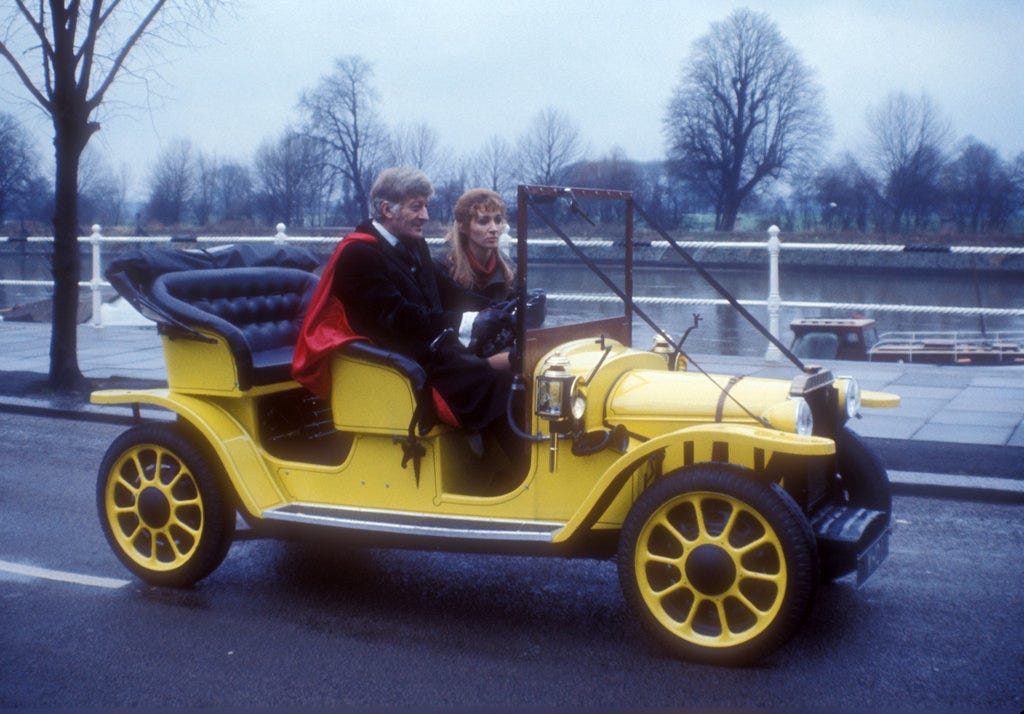
First appearance of Bessie, which isn’t the same car as in Spearhead from Space.
First use of Color Separation Overlay (CSO) for scenes like the dinosaur in the room.
Original color prints were lost but the color was restored from off-air recordings, records, and more. Was distributed in black and white for much of the ’80s.
Last story to not have the “scream” in the lead-in to the closing credits.
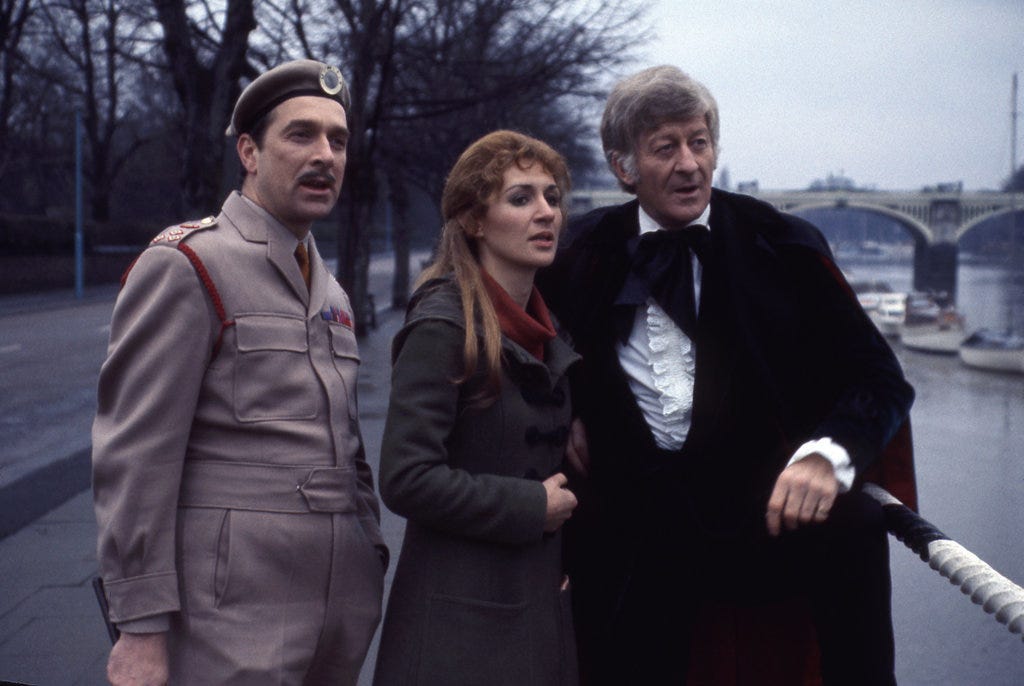
Pete commentary:
Season 7
First a quick word about Season 7, since we won’t be coming back here again now that we’ve got bingo. Has there ever been a more successful season of classic Doctor Who? The stories are great enough to stand on their own, but coming out of Season 6, which could have put the show on course for oblivion, Season 7 had no right to be as good as it ended up being. After a promising start in Spearhead, the season takes flight with The Silurians and never comes back down. Just an incredible run.
Notably, our good friends at The Doctor Who Show just did a List Makers episode on their favorite seasons of the classic series and BOTH Dave and Rob picked Season 7 as their No. 1. Fan consensus is in, and it’s a banger season.
‘Aliens’ on Earth
With the Doctor confined to Earth, the creative team needed to come up with interesting ways to do monsters without having space aliens invading every week. The idea of a pre-human civilization is inspired, and the Silurians is the first modern take on the idea (although HP Lovecraft dabbled).
The story has been tremendously influential. Not only has it inspired several sequels in the show, an X-Men story referenced it when dino-human versions of the Marvel heroes arrive on our Earth, and it even name-checks the Brigadier (although he’s not seen). The story ends with the dinosaur people telling the humans to be more respectful of their environment, and bragging that their technology is so “natural” that, if their civilization were to ever disappear, all their buildings, equipment, etc. would simply be reabsorbed into the ecosystem. It comes across as an explanation for why humans have never found any trace of Silurian or Sea Devil civilizations in the fossil record.
Just from the color and texture, it seems clear the Silurians’ technology is intended to be more “organic” than human tech. The production team is limited by what they have, though, so it’s more mechanical than it looks in later appearances (though clearly the Silurians have some equivalent of plastic and metal).
The Voth in Star Trek: Voyager are nearly identical in concept: a civilization of dinosaur people who left Earth to explore the stars, eventually ending up in the Delta Quadrant. The makers of that show have never said the Silurians were an inspiration.
Land of the Lost’s Sleestaks are another take on the idea, though that show was supposedly set in a pocket universe, not the past per se.
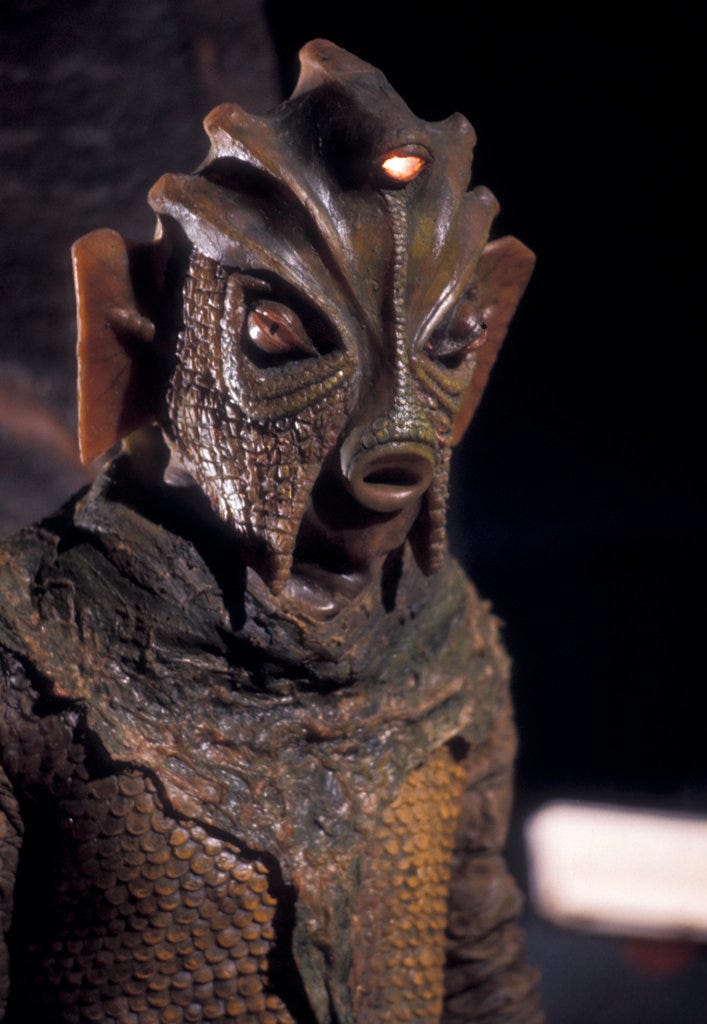
When are the Silurians from?
Going from this story alone, there’s a strong implication that the Silurians are contemporaries of dinosaurs (or at least the great reptiles of the Triassic), given the “watchdog.” Still, the dinosaur doesn’t resemble any dinosaur we know, so that means it’s either something not in the fossil record (certainly possible) or a creature the Silurians have engineered/modified.
It seems HIGHLY unlikely the Silurians are from the actual Silurian period, since the most dominant animal life was arthropods (centipedes, etc.) and early fish.
In the Sea Devils, the Doctor later speculates the reptile people are from the Eocene period, but this makes little sense either since that’s well into the age of mammals. It seems unlikely an intelligent reptile would emerge during this period.
That said, the Silurians refer to the humans as “apes,” which only arose in the wake of the dinosaurs’ extinction. Perhaps a gap in the fossil record?
Later stories would cement the Silurians’ connection with dinosaurs, most especially Dinosaurs on a Spaceship. However, that episode depicts the Silurians having the tech for a space ark, which brings up the question why they ever needed to go into hibernation.
Notably, the Silurians never call themselves by that name.
Doctor Who?
The title, “Doctor Who and The Silurians” was a simple mistake, but Bessie’s license plate clearly was not. It’s a rare onscreen reference to the show itself, and one that Barry Letts says he never would have approved. But since he wasn’t available, the show went ahead and did it, and the person in Britain with the actual “WHO 1” license plate wrote to complain that he wasn’t credited.
Pertwee strips to a T-shirt in episode 7, once again revealing his snake tattoo. I believe this was the last time we see Pertwee’s tattoo.
Suspenseful Story, Complex Villain
This story takes three whole episodes before we see a Silurian, and those episodes are a master class at world building and creating suspense. We DO see a dinosaur in the first scene, so it’s not like we’re bored, but it’s a great mislead: the dinosaur isn’t the monster—or at least, it’s not the interesting one.
There is tension immediately with Peter Miles as Lawrence being a complete dick to everyone he suspects is trying to slow down his project. Plus there’s clearly something going on with Doctor Quinn and Miss Dawson. Power losses, people going feral, tons of spelunking! By sheer variety, the story doesn’t bore you.
Episode 2+3 also give the outstanding Silurian POV shots! The three lenses is so cool, giving the sense of an alien thing while also nicely aligning with the Silurian third eye (which we see later).
Once the Silurians arrive, things move faster. The Silurians’ plans go from
stealing power to
killing the UNIT soldiers to
negotiating peace to
wiping out humanity with a plague to
taking out the Van Allen Belt (Ozone Layer?) to
reviving themselves to
killing everyone with radiation to
going back into hibernation.
Whew, that’s a lot! However, none of it feels too forced, and goal tend to naturally follow the previous ones, at least most of the time.
The Silurians’ third eye basically ends up being a kind of magic wand. Nonetheless, you kind of “get it”—it’s a way to focus some type of psychokinetic energy. Sometimes that means killing people, sometimes it means melting (and reconstructing!) a wall. It’s definitely a little too convenient sometimes, but most of the time it works.
The absolute best thing about the Silurians, of course, is that they’re complicated: Different Silurians have different ideas on what to do about the humans, a refreshing change from one-dimensional monsters like the Ice Warriors or the Cybermen. The Silurians have “texture,” and it goes beyond just the basic war-vs-peace perspectives of the Young and Old Silurians. The scientist has a manner and logic to him that contrasts nicely with the Young Silurian. They even move a bit differently.
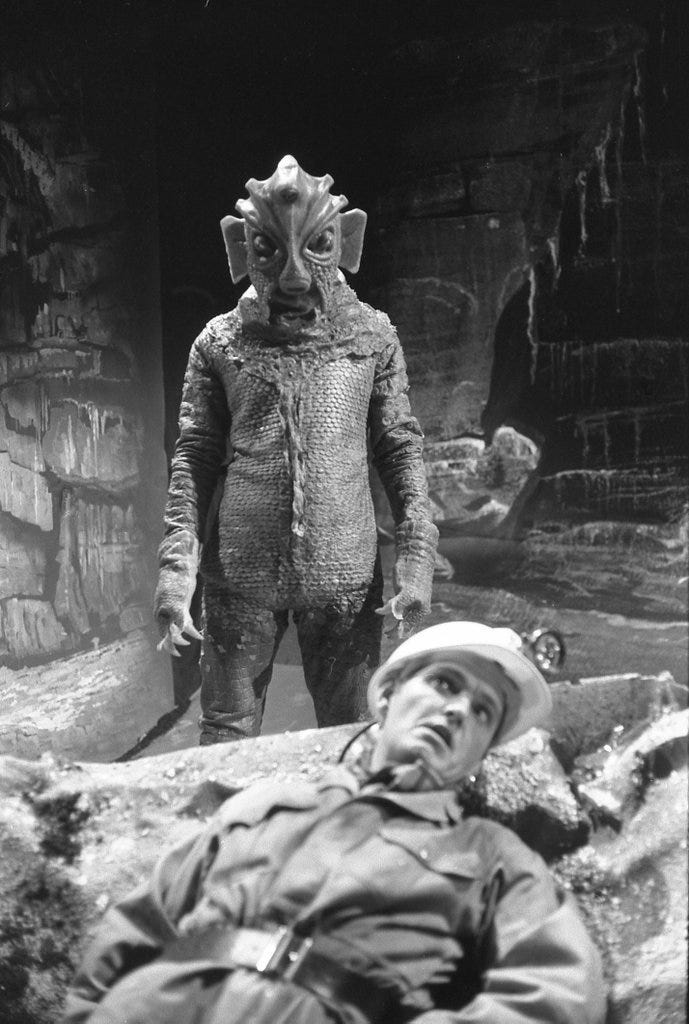
Speaking of movements, the overall twitchiness of the Silurians is an excellent choice. It probably came about from the actors not being able to move their faces much at all, so they need to punctuate some dialogue with head movement. And it works: the right lines and actions get emphasized, and it makes them seem a bit more alien.
On the design: I think this is by far the best Silurian design. It’s humanoid but clearly not human, and even though you might CGI or at least animate the eyes today, I like them a lot better than the “human eye” versions we got in the new series. I also like the fin-like ears, the ridges on the head, and the claws. Just outstanding work—a shame they never brought this specific design back. The “update” in Warriors of the Deep is just shameful.
Performances
Watching the serial this time, I was much more appreciative of the performances. Everyone is bringing their A-game. Pertwee looks like he’s been performing in the role for years, he’s so confident. Nick Courtney and Caroline John are both at their peak, with Liz having the exact right balance of standing up for herself as a scientist and deferring to the Doctor.
I love the scene where the Brig is trying to get her to man the phones, she pushes back, but the Doctor, correctly and with the right tone, reminds her of what the priority is. Top marks: gives Liz’s credentials and allows her some agency, underscores the Doctor’s rationality and overall approach of communicating in a way that’s effective—exactly what he’s trying to do with the Silurians.
The guest cast delivers, too:
Peter Miles understood the assignment—he clashes with Pertwee early on, and you understand you’re supposed to love to hate this guy. Though, certainly, his schtick gets a little old after five episodes (he dies in episode 6).
Norman Jones as Major Baker is a good second human foil for the Doctor. The script is smart in showing his turn when he believes the Doctor to be a traitor. You definitely understand, if not empathize, that he believes everyone around him is taking crazy pills.
Story
Generally, the script is very good at making the conflict feel natural and not forced. Quinn is selfish, which creates some nice mystery and dramatic irony in the early episodes. Then it’s all about what to do about this obvious and growing threat from the caves while getting resistance, fueled by incredulity, from the people in charge. I prefer this version of the Doctor connecting to modern day than the President of Earth stuff of the Capaldi era. Definitely more of an underdog.
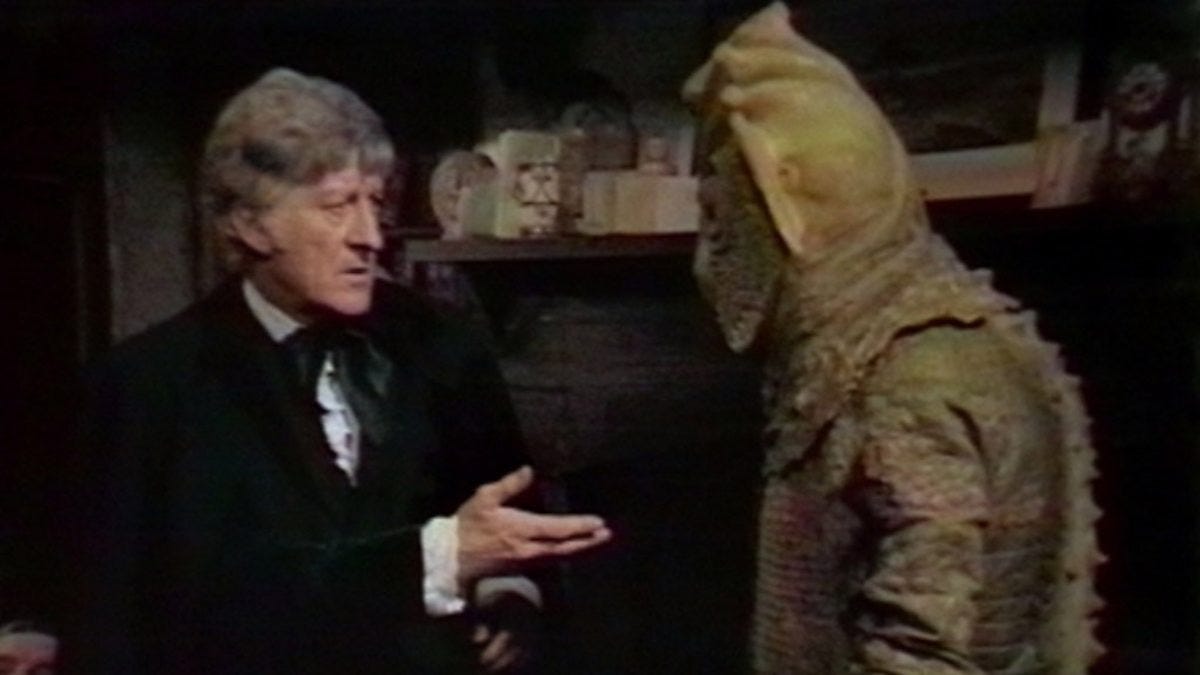
I love love LOVE the resolution to the episode 3 cliffhanger: A probably hostile alien just walks in the room, apparently to attack the Doctor. How does he get out of this scrape? By staying calm and talking: “Hello. Are you a Silurian?” This is perfect Doctor Who—this is the show: the Doctor in charge, winning through intellect, curiosity, and respect for other life forms.
Weird choice of the Doctor to not tell the Brig that Quinn is dead. Barely understandable, but surely he’d know it would backfire at some point.
Love the fourth-wall-breaking Silurian: “I am the leader now.” This guy watched The Feast of Steven.
Weird detail that was later ignored by everyone: The Doctor claims to be “several thousand” years old.
The plague scenes are really scary. I think they overdid it on the makeup, but watching people collapse in the train station and the streets around is quite effective, making the production seem bigger than it was. Camera angles are cool and surreal too.
There are no stairs to get out of Wenley Moor?
Music
It has to be said: Carey Blyton’s music is bonkers! But it’s also quite memorable. He definitely never got the memo that a successful soundtrack should never be noticed.
It actually starts out pretty well, but quickly goes way over the top.
I can’t really watch the serial without thinking about the kazoo-style “beeping” when the Silurians do something dramatic. I definitely appreciate it and I quite enjoy the OTT Pertwee-style music that carried over with Dudley Simpson.
Genocide!
So the Silurians were planning a genocide, so the Brigadier genocides them right back! This is a very ugly choice, morally, and you almost wish that The Silurians came later in Pertwee’s run to make it more of a wedge that gets driven between the Doctor and UNIT.
You can steel man it somewhat—the Silurians were clearly hostile, and their power level isn’t fully known. The risk of reviving them is arguably too great, given the scale of their hostility and their level of technology. And leaving them be just postpones the threat. Not a view the Doctor supports, of course, but you have to picture an offscreen scene where he and the Brigadier go at it, and he fully makes the case. He wouldn’t persuade the Doctor, but perhaps there would be begrudging understanding of the position.
Is it a full genocide, though? The Brigadier says he wants the base “sealed permanently,” not “destroyed.” The final scene shows the hibernation unit opening behind the Young Silurian as the cavern collapses, plus you hear the “revive” sound. Were they planning a sequel all along? Warriors of the Deep kinda-sorta suggests that the Silurian leader in that adventure is the same guy as the Old Silurian.
Generally, though, fan consensus has settled on this group of Silurians being wiped out here. Like I mentioned at LI Who, you kind of need to do a genocide at the end of Silurian/Sea Devil episodes. Otherwise, you’re stuck with a group of creatures who should logically be hell-bent on finding and reviving other members of their race, which are supposed to be all over the planet. Then you’re in alternate-Earth territory, where the Doctor Who universe doesn’t resemble ours in the slightest.
What did Pete’s family think?
Grace came in at episode 4, and she was incredulous that anything had happened in the previous three. She said she could completely keep up with what was going on. I think that speaks to the slow build-up, but that build-up is necessary to really appreciate the story, I think, because she liked it, but wasn’t blown away by it.
Four Questions to Doomsday - Pete
Why did the Randomizer take us here? Musical contrast: The War Machines had virtually no music, and this one is the other extreme: music all over the place and in your face. (Thank you, Carey Blyton). Also jumping ahead to what The War Machines begat: the Doctor interacting with contemporary Earth, which of course the Pertwee era is all about.
The biggest connection, though, is with Daleks in Manhattan/Evolution of the Daleks, with the Doctor fighting for the survival of a new species, and expressing total disgust when they’re genocidally killed off.
What if the evil plot had succeeded? This is a case where we know exactly what would have happened if the Silurians won the day because that story’s been written: The novel Blood Heat is set in a parallel world where the Doctor is killed in the course of this adventure and the Silurians take over. Years later, the planet has become a tropical world ruled by the Silurians, who generally see the remnants of humanity (including the Brigadier and other UNIT personnel) as a nuisance as they continue to rebuild their civilization. The humans nearly launch a genocidal war against the Silurians, but the Seventh Doctor prevents it and forces the two sides to make peace.
Where’s the Clara splinter? She runs a “Potholer Outfitters” kiosk, converted from a storage room Wenley Moor. She always has plenty of overalls in multiple sizes, has a very liberal payment plan (“Get me next time”). and all of the overalls, helmets, ropes, etc. are made to be put on and taken off very quickly.
Dalek, Ogron, Professor Hayter, Viscount Banger, Fixed Point in Time, Lady Cassandra, or Zarbi? Loved this one as a kid (despite it being in black and white for the longest time) and it still holds up. It really is a great concept, and an excellent script. Everyone delivered on this one. No doubt—this is a Viscount Banger.