

Plot Summary
An alien force hijacks the TARDIS to 15th-century Italy, empowering an ancient cult to push humanity away from the Renaissance and back to the ways of superstition.
Notable for:
The opening story of Season 14, and the first historical or pseudo-historical story since The Gunfighters not principally set in Great Britain
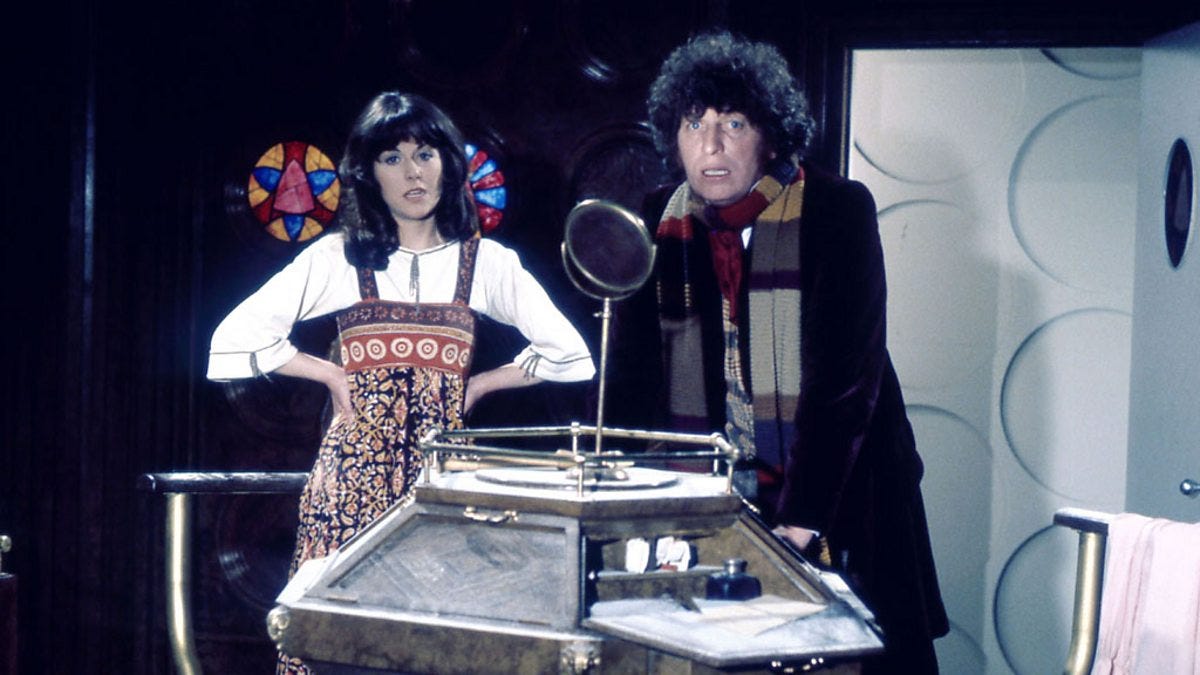
First appearance of the wood-panelled secondary console room, designed by Barry Newbery; it was used until The Robots of Death, after which new producer Graham Williams restored the original interior
First on-screen explanation of how companions understand other languages: the Doctor calls it a “Time Lord gift” he allows Sarah to share
Debut of a new police box prop designed by Barry Newbery, retiring Peter Brachacki’s 1963 original; accounts vary on whether the old prop’s roof collapsed while Tom Baker and Elisabeth Sladen were inside
Filmed on location at Portmeirion in Wales, best known as the filming location for The Prisoner; Philip Hinchcliffe suggested it after visiting as a tour guide in the 1960s
Hinchcliffe was inspired to set a story in Renaissance Italy by Roger Corman’s 1964 film of The Masque of the Red Death
Louis Marks’s last Doctor Who story; he had specialised in Renaissance Italy while completing his doctorate
The Mandragora Helix is named after Machiavelli’s comedy La Mandragola, and Hieronymous is a Latinate variant of the first name of doomsday prophet Girolamo Savonarola
Elisabeth Sladen stayed under contract an extra seven months because she wanted to make this story; without it, she would have left in Season 13
Working titles included Catacombs of Death, Doom of Destiny, Secret of the Labyrinth and The Curse of Mandragora
First story with the new serif font in the credits
Pete commentary:
The very first thought I have about the Masque of Mandragora is how gorgeous it looks. The costumes, the sets, the location work all look amazing. You can tell this is at the beginning of the season since they’re confident in their budget and production values.
It’s apt that the “old” console room is here. Strange we’ve never seen it before considering it’s got stuff from Troughton’s and Pertwee’s Doctors.
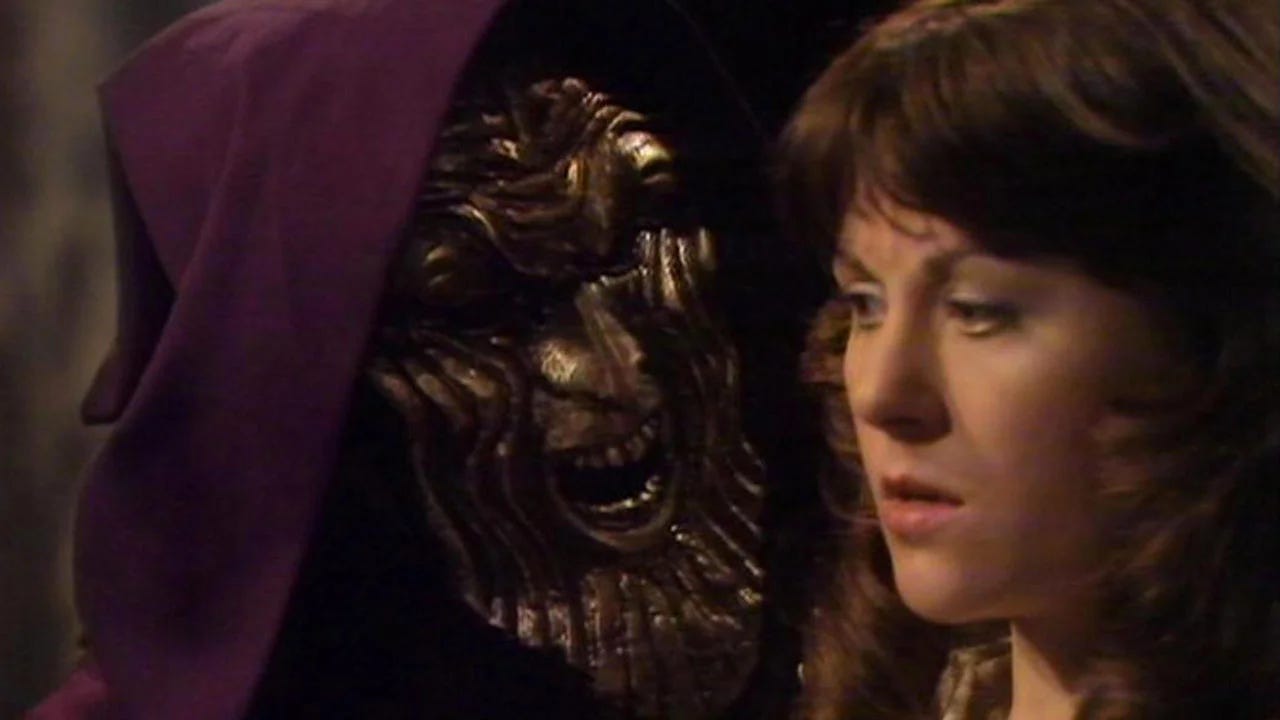
A word on the masks: superb and creepy, and they really add to the idea of evil. The idea that some otherworldly power could amplify the power of extremists is an ongoing fear, of course, and it projects well onto the nuclear age and now, AI.
So many stunning costumes:
The maroon-and-yellow uniforms on soldiers
Hieronymous’s lavender cloak
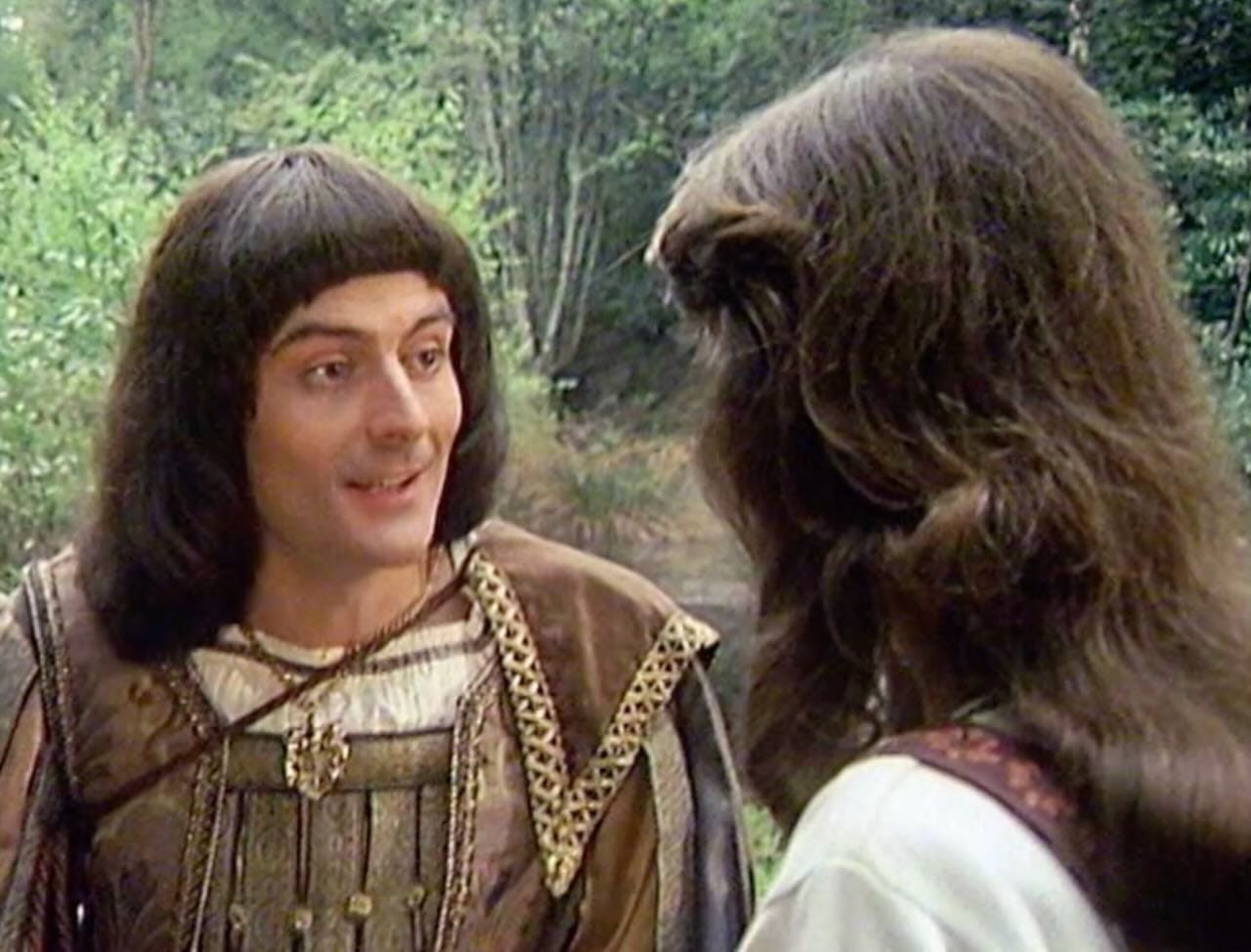
Federico’s and Rossini’s red outfits
Federico’s amazing hats
Everyone at the masque
Worst choice: Guiliano’s wig 🤮
The evil plot here is an interesting variation on the standard alien invasion. The Mandragora Helix isn’t interested in resources or conventional conquest per se. It mostly wants to keep humanity from ever becoming a “competitor” in the cosmos, by preventing the Renaissance from ever happening. This suggests that the Helix has some kind of influence or presence in the galaxy or universe. Interesting idea, sadly never revisited.
Running with the AI idea for a minute: I think the story’s themes are resonant in the AI era. There are very existential questions that are now being examined. When AI can solve advanced math problems, for example, it forces us to think about what learning even is. In a way, you could argue AI is the modern-day equivalent of the Helix, promising unprecedented power but robbing humanity of an essential ingredient of progress. And the AI barons—Altman, Amodei, et al.— are stand-ins for Hieronymous and his Cult of Demnos brethren.
The dancing of the cult members is pretty lousy. You have to be sympathetic since they probably can’t see a damn thing. But the Sisterhood of Karn still wins.
The climactic scene between Hieronymous and the Doctor doesn’t look great but it works on a story level. It just would have been good to have more indication that Hieronymous was exhausting himself with every blast. And is the Doctor faking or actually being hurt?
That said, I think they wrote themselves into a corner by vaporizing the victims of the “zaps” of the brethren. Electrocution was enough, and it would give the ending more credibility.
It’s also a nice bit of misdirection when Hieronymous (actually the Doctor) shows up at the masque. However, some people were killed, yo! Not the best plan to convince Guiliano to do it after all, Doctor. What if Leonardo was one of the people killed?
So this story is probably best remembered as establishing Doctor Who’s version of the “universal translator.” The weird bit, though, is that Sarah gives herself away as being mind-controlled because she notices she can understand Italian perfectly. This strongly suggests that there’s almost some kind of perception-filter aspect to this “Time Lord gift.” That part, thankfully, has been forgotten about, and now companions notice this ability left and right in the new series.
Lots of action here, which is great fun. The Doctor gets to show off his swordfighting ability—I think the first time since The Sea Devils. Must have had that lesson with Cleopatra’s captain some time ago. And by Robot of Sherwood he’s perfected his technique so he can fight with a spoon.
The masque itself is pretty fun.
Giuliano’s wound sure heals fast.
What did Pete’s family think?
Grace noticed the outfits throughout. She was really impressed. Otherwise, she didn’t really “get it.”
Four Questions to Doomsday - Pete
Why did the Randomizer take us here? Electricity: obviously a big connection to Nikola Tesla’s Night of Terror. Tomb of the Cybermen was also all about using your power efficiently. And, of course, our moment in AI.
What if the evil plot had succeeded? The Doctor’s breastplate doesn’t work, or the wire isn’t properly grounded, and Hieronymous succeeds in killing him. Everyone is executed at the masque, and the brethren spread the Helix’s power throughout the world, selectively putting people in charge while turning everyone else into “sheep,” as the Doctor puts it. It becomes a backward, primitive world, never becoming a spacefaring power. It’s easy pickings for the Cybermen when Mondas returns to the solar system in 1986, the Daleks when they want to invade in the 22nd century, and a host of other alien threats. It becomes a battleground planet, but never of much strategic importance.
Where’s the Clara splinter? She’s the hostess for the masque. For key people (like Leonardo), she gets them in the “VIP room” so history isn’t disturbed.
Dalek, Ogron, Professor Hayter, Viscount Banger, Fixed Point in Time, Lady Cassandra, or Zarbi? I think this mostly a Cassandra, but I like that it tries to do something a little different than your normal alien invasion. And it’s metaphor and turning-point-in-history background has new relevance today. Cassandra-Dalek hybrid.
Chris commentary:
We have a Louis Marks bingo! (Planet of Giants, Day of the Daleks, Planet of Evil)
Love the tiny detail of the Doctor increasing Sarah’s height every time it’s mentioned.
Based in part on the Prince, based in part on the Masque of the Red Death – which has one noticeable difference, in that there are women with speaking parts
Gareth Armstrong and Tim Piggot-Smith, as Toby Hadoke noted, are playing Giuliano and Marco as more than just “companions.” Armstrong had a great range as an actor and had clearly chosen to go a bit fey …
Indeed, everyone is playing everything as campy and fruity as possible, and the script gives them ample opportunity. Even down to the fact that the stunt extras stuffed their cigarettes in their codpieces; the director loved that.
Mandragola = mandrake root, believed in medieval times to be produced from the semen of hanged men!
AKA “Doctor Who: Men in tights”, as About Time puts it. Or “Doctor Who left that bloody TARDIS door open?”
Headcanon: Sutekh got hit with Helix energy as it left the TARDIS.
History corner! Where the hell is the Catholic church? And no, Giuliano was not unusual in thinking the world round – all scholars did.
Hieronymous – his name is sometimes pronounced Geronimo – is based on Savonarola, the friar who kind of kickstarted the Reformation in Florence … and condemned “sodomites” to execution. (Florence was previously a very tolerant city.)
The Doctor’s Latin line, walking will solve it, is the solution to Xeno’s paradox.
He’s off on his Galileo telescope estimation by about 60 years.
Thank you!
Fun fact about dancing in this episode: the Renaissance dance you can see in Part 4 is an actual Renaissance dance! The music you can hear in this scene is called Basse danse La brosse - Tripla - Tourdion by Pierre Attaingnant (c. 1494–1552)
The dancers who worked on this episode include Peggy Dixon, a celebrated choreographer of early dance who helped found the Nonsuch History and Dance educational charity in the 1960s.
It's so lovely to see actual historical dance in Doctor Who! Actually, I'm working on an article about dance in Doctor Who - that's what you get when you mix a Whovian with a dancer :)
Thank you!
Fun fact about dancing in this episode: the Renaissance dance you can see in Part 4 is an actual Renaissance dance! The music you can hear in this scene is called Basse danse La brosse - Tripla - Tourdion by Pierre Attaingnant (c. 1494–1552)
The dancers who worked on this episode include Peggy Dixon, a celebrated choreographer of early dance who helped found the Nonsuch History and Dance educational charity in the 1960s.
It's so lovely to see actual historical dance in Doctor Who! Actually, I'm working on an article about dance in Doctor Who - that's what you get when you mix a Whovian with a dancer :)