

Plot Summary
In the far future, humanity’s last hope is a generational ship built to endure anything… except the common cold.
Hey! Pull To Open is featured on Recap Scout! Of course, it’s an honor just to be nominated, and we definitely recommend checking out some of the other Who podcasts listed. Check them out right here 👇

Notable for:
First full story for companion Dodo Chaplet, who had briefly appeared at the end of The Massacre of St Bartholomew’s Eve
First Doctor Who story to be set definitively in humanity’s far future and the first to depict the end of Earth
First time a female writer (Lesley Scott) received a credit on the series, though her actual contribution to the script was reportedly minimal
The final episode, “The Bomb,” was the first in Doctor Who history to be recorded out of story order, grouped by set availability — a then-groundbreaking production technique
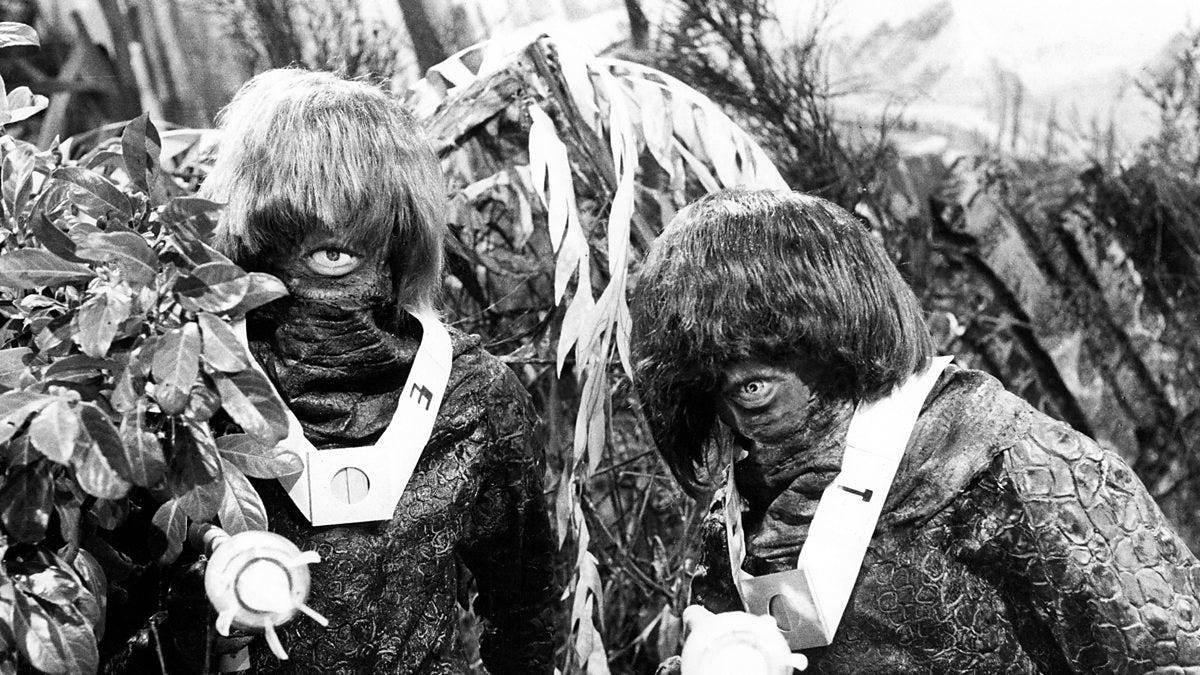
The Monoids were created by having actors hold ping-pong balls in their mouths to represent a single eye, and wearing wigs made from Yak hair
Director Michael Imison made sophisticated use of forced perspective and playback technology, unusual for the era
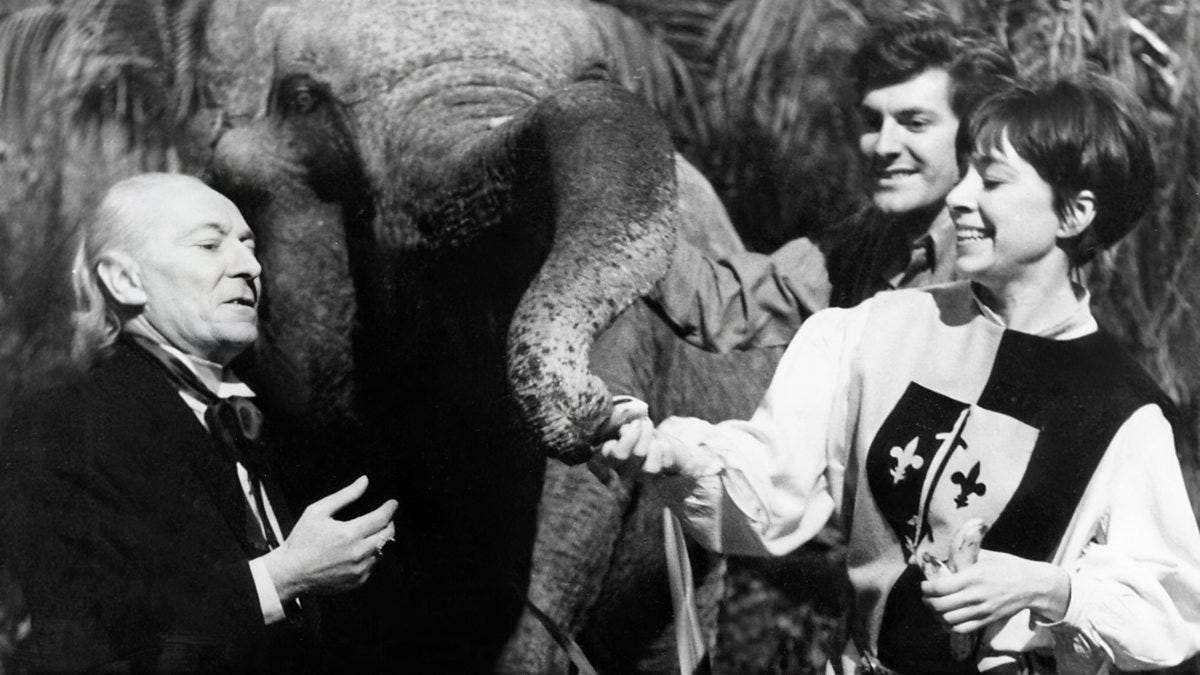
A live elephant named Monica was used in production; her trainer was denied studio parking, so the animal spent the night in a van outside the director’s home
The story was originally known by the working title The Space Ark
Ratings increased over the story’s run, from 5.5 million viewers for the first episode to 7.3 million for the finale
Pete commentary:
Doctor Who is often set on Earth, and even contemporary Earth, but I often admire the show for taking advantage of its large canvas by upping the scale with regard to time, space, stakes, etc. The Ark shows they were doing this very early. Even though subsequent episodes would go even further, setting a story 10 million years in the future is wildly ambitious for the time. Society was only starting to understand, in a mainstream kind of way, that there are many millions of galaxies, space is expanding, and the relative age of the Earth, solar system, and universe. Huge points for going for it.
That said, I’ve always wondered why human beings would be relatively the same so far in the future. You’d think we would have evolved. Certainly, you have to cast real people in roles, so you can’t go that far with this idea, but it would have been interesting to see it addressed, even if it was something like, “Once societies reach a certain tech level, evolutionary progress stalls because social systems override natural selection.”
The story is really innovative, playing with the show’s format by splitting the story in half, across two time periods. They gloss over exactly why the TARDIS returned to the same ship 700 years later, but even without The Doctor’s Wife’s “I always took you where you needed to go,” you could argue a setting just got stuck (which always seemed to be happening in Hartnell episodes anyway).
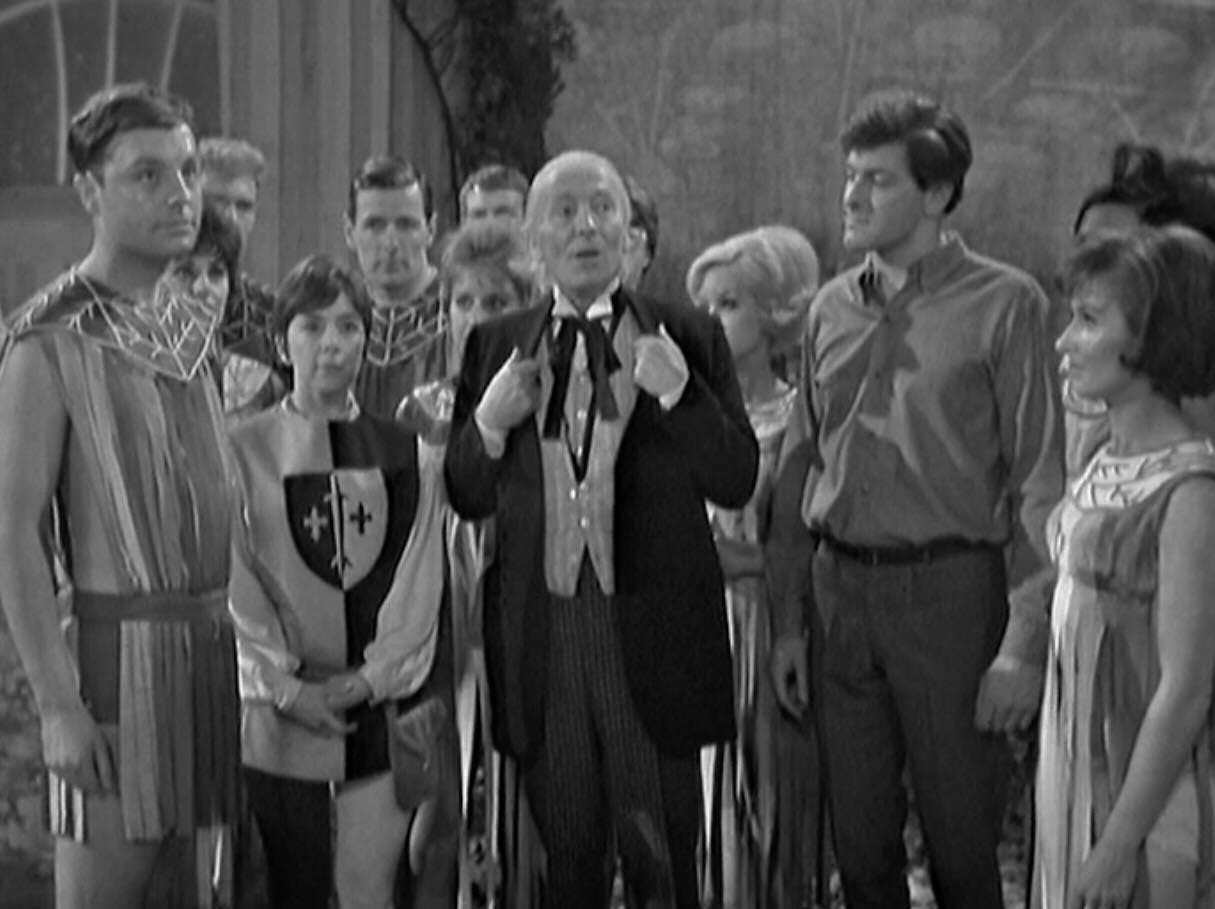
The premise is great: The Earth is gone, but humans have invested all their resources to create a massive colony ship to settle a planet so distant that it will take them 700 years to reach it. At this point in the show not much future history has been established, so it sounds credible, though later stories rob The Ark of its uniqueness. Even if you overlook colonies, Frontios and Smile both show similar groups of the “last humans” settling other planets. I actually think this is a strength of the show: Sure, you can debate whether this disaster is the same one across episodes—and how it reconciles with Ravalox and The End of the World—but I like how each story basically revolves around what sounds like the same cataclysm. It all makes sense, if you don’t look too close (but of course, as fans, we will).
The first two episodes are amazing in that they tell a gripping story without any conventional monster or villain. The monoids are a bit freaky looking—which is great—but then they flip that expectation by making them (seemingly) benevolent servants. There’s a lot of parallel here with the Ood in The Impossible Planet, who also end up becoming the baddies (although without the same agency as the monoids).
Instead, the story becomes a “race to find the cure” story, while trying to parry the (understandable) suspicion that Zentos is aiming at them. The story succeeds by afflicting Steven, who we care about since he’s the hero and written to be the most sensible. Meanwhile, the Doctor and Dodo give the emotional weight. Hartnell appears to be deliberately playing the Doctor more cantankerous than normal, making us sympathize with Dodo as she sniffles her way through.
Nice bit of foreshadowing from the Doctor, speaking to a monoid: “You know, you’re far more knowledgeable than most people realise, aren’t you?”
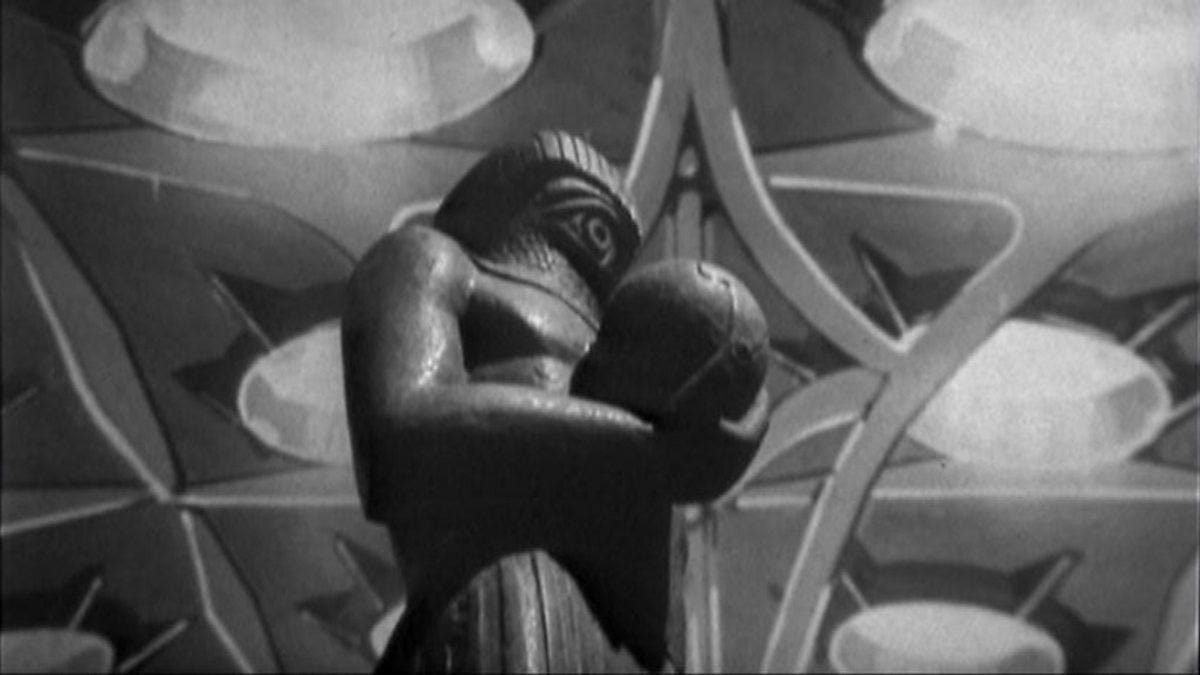
Any hint of what’s to come is pretty subtle though. Grace said, as episode 2 was wrapping up, “Is this a two-parter?” which I remember thinking the first time I saw it. But wow is that cliffhanger spectacular: the slow pan up the statue to reveal the monoid head! I remember being blown away by that. And the music is perfect. One of the all-time great cliffhangers!
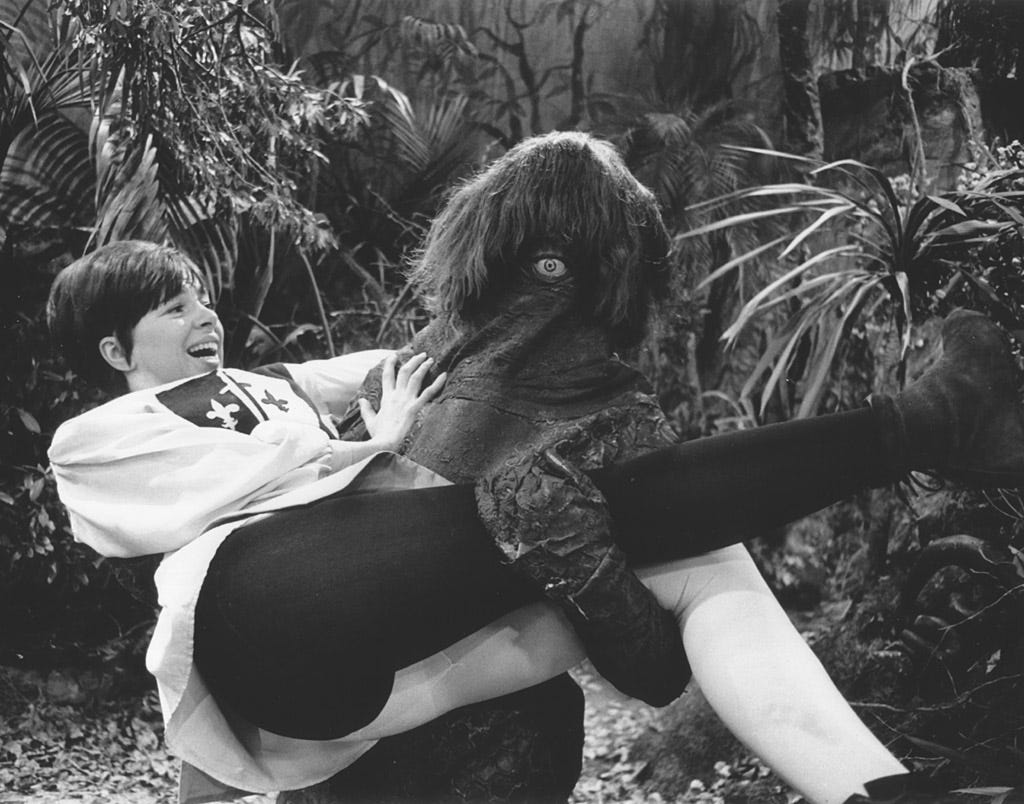
The later two episodes obviously take a turn and become a more traditional Doctor Who episode, with a proper monster. But because we have the background of the first two episodes, we are more invested in the stakes, and moreover we actually care somewhat about the monoids, even though they’re being absolutely despicable jerks.
One thing that always bothered me about the monoids is that you often see them putting down drinking glasses or swatting away trays of food. How do they eat, though? Where are their mouths exactly?
I must say, I need to call out the false equivalence the story seems to advance. While it’s true that the monoids didn’t have equal status in the first two episodes, they were not treated anywhere nearly as harshly as the monoids treat the humans. And unless the commander is lying, they went into this arrangement eyes wide open: “They offered us their invaluable services for being allowed to come on this joint voyage.” Yes, things change, and yes, all sentient beings deserve equal rights and respect, but I would push back on the Doctor when he says, “They were treated like slaves.” I honestly see very little evidence that the monoids were mistreated.
That matters, because for anyone trying to apply the lens of today’s politics onto this story, it actually makes a solid case for better immigration/assimilation control. We may not have a virus that saps our will, but it seems to show that taking on refugees brings with it huge risks if you don’t do it exactly right. And even if you do, some angry agitator might take control anyway and instill a centuries-long culture of revenge from revisionist history.
That said, the ultimate message—that the correct path to peace is trust and treating each other as equals—is obviously a good one. And I understand they wanted to preserve the surprise at the end of episode 2, which is probably why they didn’t show the humans mistreating the monoids in overt ways. But it does make you sympathize less with the monoids when the tables are turned.
It would have been interesting to see mixed races among the Guardians. Since this is 1960s Doctor Who, they’re all white, and of course the monoids have a dark colored skin. But I do think the racism metaphor is something to be careful with since it shows the former slaves behaving terribly.
With the Refusians, the story makes an interesting species out of what was clearly a budgetary decision: By making them invisible, you don’t need another costume. Also, a second alien world detract from the monoids and another human-looking race would be a bit silly in a story about humans going to a strange planet they know very little about.
Their noncoporeal nature also gives the Refusians more credibility as a “wise” race. At this point, it wasn’t yet a Star Trek trope.
Love the twist of the monoid civil war. Violence always begets violence. On the other hand, the Refusian destroying the capsule with 2 in it is pretty extreme.
In episode 1, where that woman’s (Mellium) boyfriend is miniaturized as punishment, I couldn’t help but think, “I guess she’s on the market.”
Gotta say, the PPE of the colony ship isn’t great. I don’t think their masks are N95.
Interesting hint of future history: the “primal wars” of the 10th segment of time.
The kitchen is protected by some pretty basic motion-detection tech.
Is Venussa hitting on Steven? “You don’t know the Ark. You will need me to help you find the bomb.” OK, hottie.
What did Pete’s family think?
Grace said she “actually” really liked it. I could see she was engaged throughout. She and I laughed out loud when Dodo challenges monoid 2:
MONOID 2: Don’t worry. It may not take as long as you think.
DODO: What do you mean? Are you up to something?
MONOID 2: Er, no.
🤣🤣🤣🤣🤣🤣🤣🤣🤣
Four Questions to Doomsday - Pete
Why did the Randomizer take us here? The Cold War? The Doctor almost freezing to death? Here he’s obsessed with keeping infected people warm. Heat is often in short supply when you travel in time and space, I guess.
Also: Odyssey. Cyclops. ’Nuff said.
What if the evil plot had succeeded? So 1 explodes the bomb, killing everybody on the Ark, including Steven and all of humanity (except for Dodo and the few people who made it to Refusis). The TARDIS HADS system activates, so it materializes somewhere on the planet. The monoids get to work creating a new planet, but the Refusians keep them from making any progress. The last humans destroy their “race banks” in an act of revenge. The Doctor and Dodo reach the TARDIS, mourn Steven, then advance another 700 years to find the few monoids and humans eventually made peace with each other and have become a new merged species.
Where’s the Clara splinter? It’s unclear how long the Guardians have been journeying, but I think Clara was the original Commander. She could be the one responsible for everyone believing they’re the Earth’s only hope, even though other ships have fled Earth. Clearly she has a “burn the ships” philosophy to help motivate the people, convincing the original crew it was necessary and destroying all evidence of the ships that journeyed to Frontios and Gliese 581d.
Dalek, Ogron, Professor Hayter, Viscount Banger, Fixed Point in Time, Lady Cassandra, or Zarbi? Love this story—it’s fantastic Doctor Who. It’s innovative, gripping, and fun. The false-equivalence morality and somewhat confused message drag it down slightly, but it’s one of Hartnell’s best. Banger-Dalek hybrid.
Chris commentary:
Surely one of the best cliffhangers of all time, that statue. I didn’t know about it and was marvelously surprised, expecting DW to be much more basic and have the simple passage of time (as shown by completed statue) be the cliffhanger. But this one gave me Lost vibes. From the good season.
Of course from there it’s all downhill. The Monoids are only interesting tyrants in as much as Monoids are interesting. And when their entire look/feel/character was an afterthought by the director, what do you expect?
I love the vast generation ship and the accidental disease spreading and 700 year time jump, but let’s be real — this is only new to Who. HG Wells and Olaf Stapleton were on this sort of trip 60 and 30 years earlier.
We should grade on a curve, but not too much. This is 1966. We’re only 2 years away from 2001 and Planet of the Apes. Some scenes in episode one come close to such grandeur, and it was so expensive they had to make the Celestial Toymaker.
Some plot holes are less forgivable than others. How ironic that The Ark’s biggest plot hole is miniaturization. Who wouldn’t just commit crimes to extend their lifespan?
They just didn’t think this through in a lot of ways. It’s annoyingly treated as disposable, after such a compelling start.
We don’t have to talk about the elephant in the room.
If only there were more Zarbi moments with this monster that clearly has Zarbi potential, but there are one or two beauts. The Monoid slowly backing his vehicle into bushes Homer style after dropping them off at the TARDIS …
First time ever that DW dropped out of the top 100 BBC programmes – during the first episode unfortunately. Thank “Thank Your Lucky Stars’ on ITV.
Poor Jackie Lane, her accent torn all over the place, the Doctor now chiding her needlessly …
there’s something a bit conservative about The Ark, and not in a good way. Hartnell is curmudgeonly, sexist, patrician, colonial, carelessly bringing colds and having people thank him for curing them!
Four Questions to Doomsday - Chris
Why did the Randomizer take us here? I was today years old when I made the connection: from the Cold War to the war on colds … You asked the randomizer for something “chill” 2x ago …
From terrible insertion of monster into Cold War metaphor to terrible insertion of monster into colonial metaphor. Myth Makers reference: is it sponsored by The Odyssey? Randomizer, are you getting a cut of that sweet sweet Nolan ad budget?What if the evil plot had succeeded? The Monoids blow up the humans on the Ark and … get their asses kicked by invisible Refusians (who start planting Monoid killing gases inside vases). Or is it the Doctor’s accidental evil plot to spread disease to the end of time? If he succeeds in wiping out both races (in part by overheating them) then … the Refusians went to all that trouble for nothing, and they go on a vendetta against the Doctor, and it is them making him disappear at the end.
Where’s the Clara splinter? She’s a Monoid — sorry Clara. But she has freakishly beautiful hair, basically becoming the Martha Stewart of Monoids on their internal TV network. She’s inspired them to rock ever more hideous haircuts, given them dumb ideas about human-run security kitchens that must have all the latest tools, and offered tips on ordering society by number (“it’s just more organized, and that’s a good thing!”) And really under it all making them angry because they can never live up to Clara the Monoid’s impossibly high standards, and they become self loathing and bitter and thus in no position to carry out human genocide without arguing with each other to the death first. (Four is a big fan.) Also this is why 2 really hates vases!
Dalek, Ogron, Professor Hayter, Viscount Banger, Fixed Point in Time, Lady Cassandra, or Zarbi? Fast forward 700 years. The people of Earth have built a statue honoring their rating for the Ark. Pan up from the bottom: a Dalek casing. Dalek balls. Good. This is a good story. Wait a minute! That head! Something has gone hideously wrong! Servants have become masters! It’s a Dalek with the head of an Ogron!