Plot Summary
One a parallel Earth, Rose must contend with the possibility that her alternate father may be working with a megalomaniac to evolve humans into machine creatures.
Notable for:
First “proper” appearance of the Cybermen in NuWho, following the presence of a Revenge-style head in Van Statten’s museum in Dalek (referenced in this story).
Introduces parallel worlds for the first time in NuWho.
Came out on the year of the 40th anniversary of the Cybermen’s first appearance.
Pete commentary:
The Re-introduction of the Cybermen
The re-introduction of the Daleks was so successful in S1, it was only natural to do the Cybermen next. The challenge for the new series was: How do you do that for new viewers (who may not be familiar) without getting bogged down in continuity? Not to mention: The Cybermen’s history in Classic Who was always convoluted and had a fundamental problem: Why was this “alien” race such a perfect metaphor for technology run amok, and hell-bent on converting humans specifically?
Flipping the Cybermen’s origins to a parallel universe was a masterstroke in simplifying all of that, while simultaneously cleaning up the Cybermen’s are-they-or-aren’t-they-human problem. Obviously it also sets up most of the character moments in this story, but it also gives the audience the opportunity to see their origins for THIS series. I honestly can’t get over how perfect a solution this was.
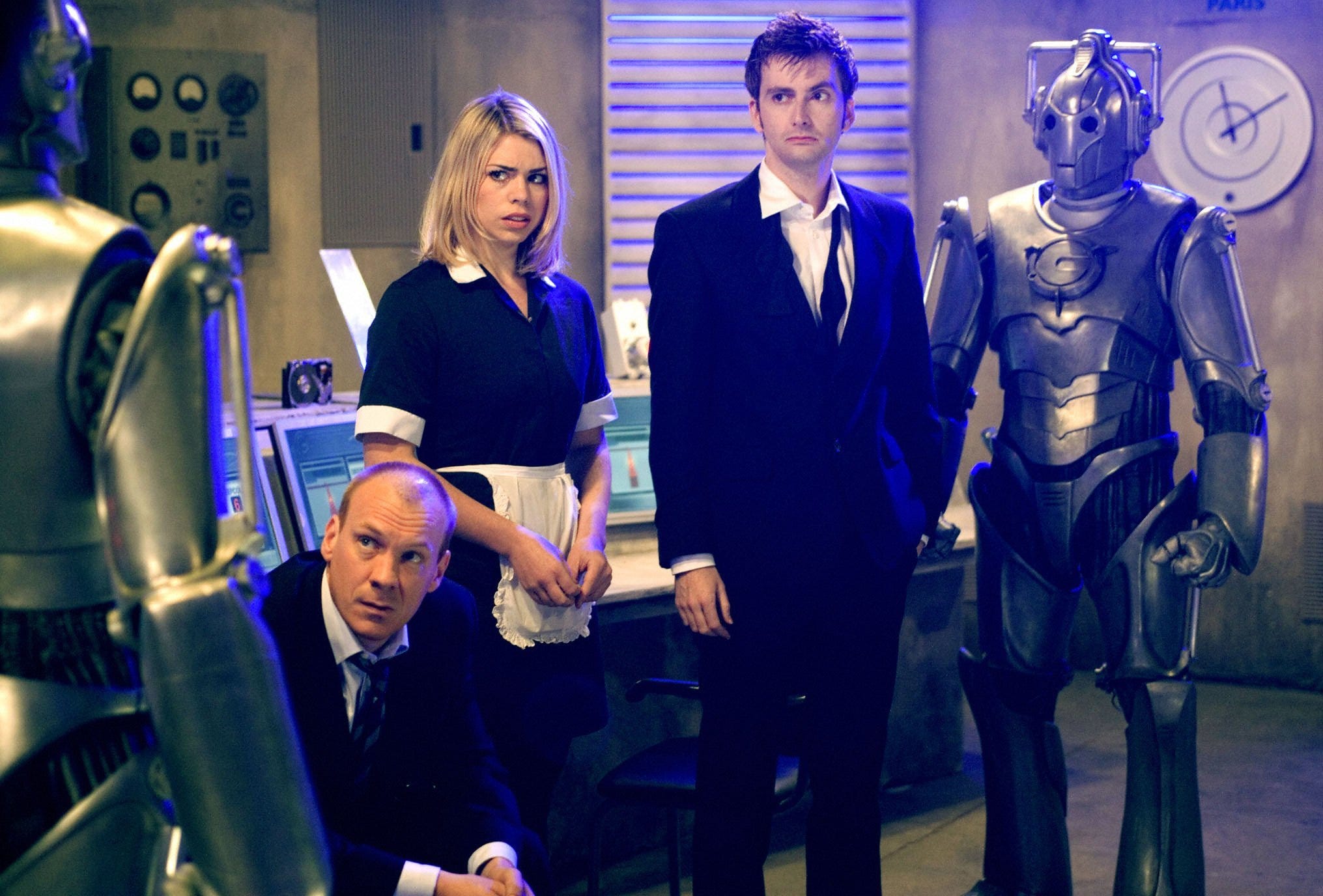
I like the choice to keep the Cybermen out of focus/off-camera for most of the first episode. As with Daleks in Manhattan, this isn’t some misplaced sense of surprise. We all know these are Cybermen—it’s right there in the title—and if you’re a hardcore fan, you’ve probably even seen the advance photos. But knowing what they are and seeing them in action, in context, are different things. It’s also a great choice to have the first time they come into focus be when the Doctor sees them.
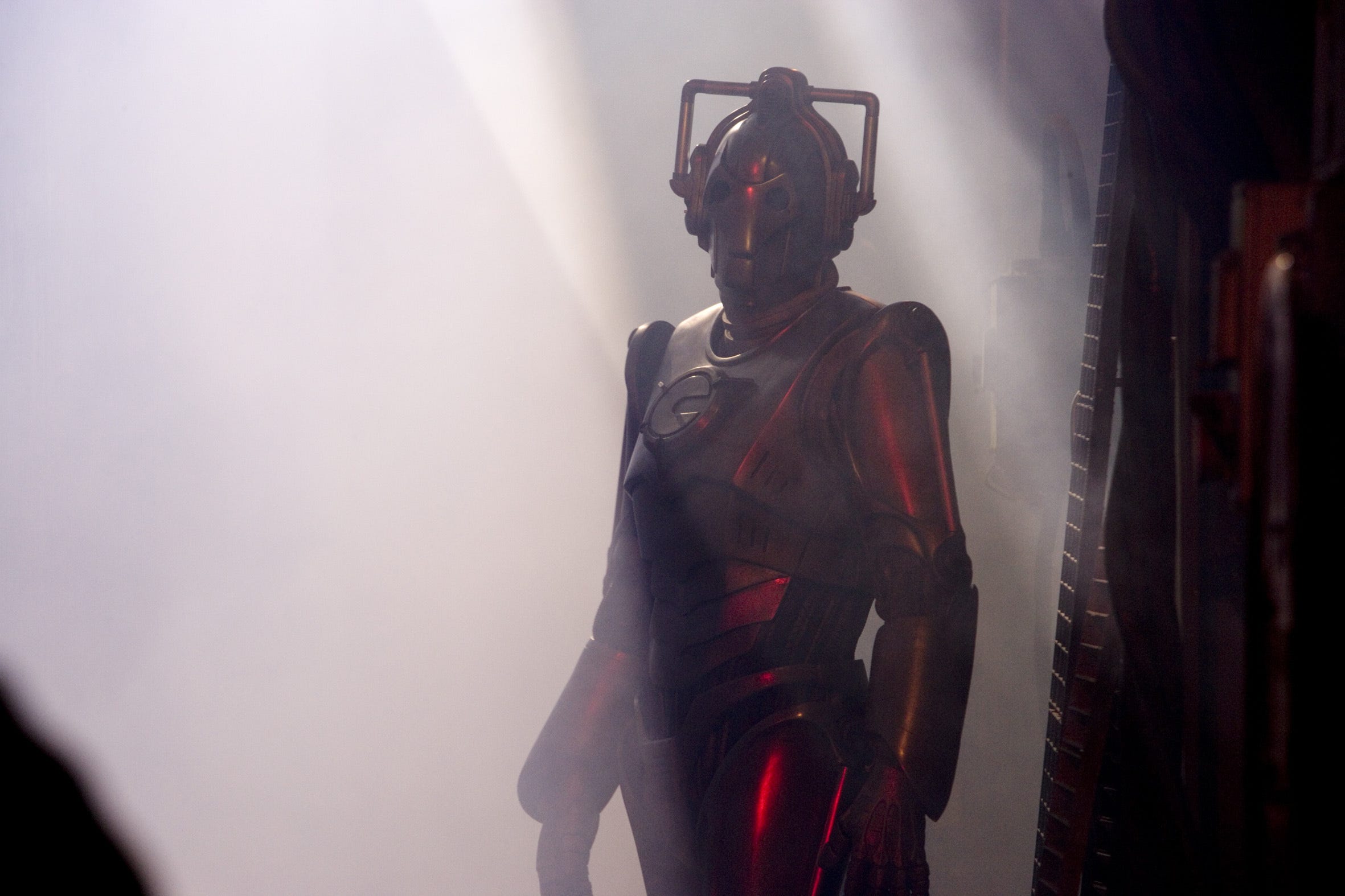
And boy do they make an entrance: smashing all the windows and instantly taking charge. It’s important to establish your monsters as formidable, and this certainly does it.
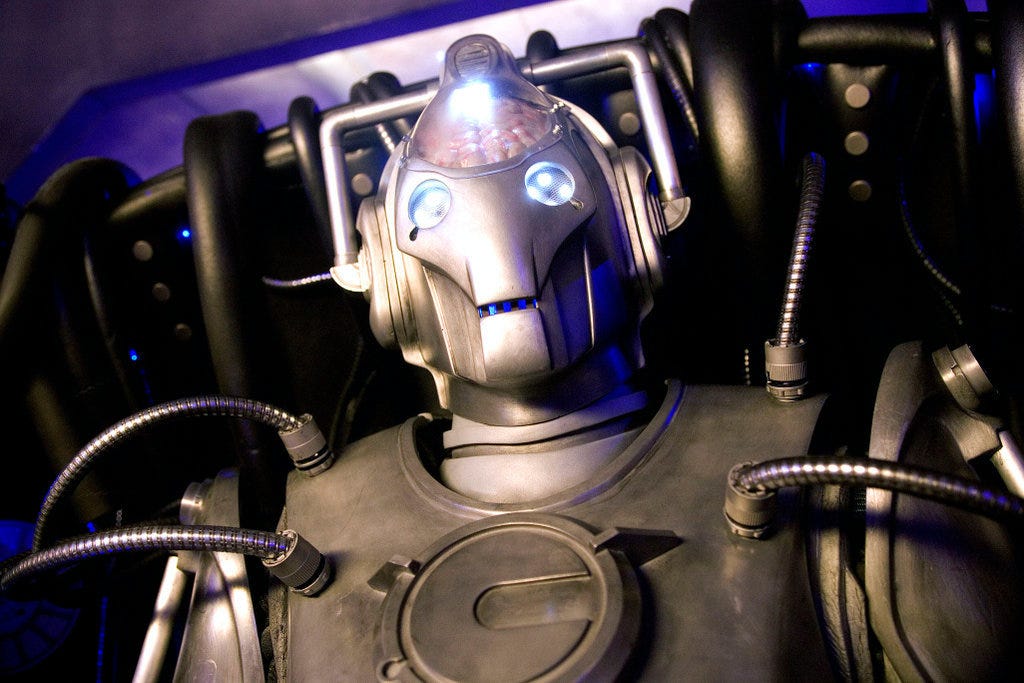
It’s great that we also have total clarity on exactly what the Cybermen are: a human brain transplanted into a suit of armor. It puts to rest (for these Cybermen anyway) what conversion means and more importantly why they’re horrific. While it doesn’t match what’s been shown before (particularly Attack of the Cybermen), the alternate-universe thing gives them a pass.
Moreover, this episode establishes (or at least very strongly implies) that the World Enough and Time theory on the Cybermen holds: There is no master plan, and no actual “race.” They are what happens when technology outpaces humanity, as Twelve put it. I like to say that they are an anomalous outgrowth when any race reaches a certain level of technology. Afterward, there is a chance that either:
a group of that race will get desperate enough to augment themselves to the logical conclusion (Mondas).
A lunatic will actually think “upgrading” is actually a good idea overall (Lumic).
It’s also great that this story gets back to the fundamentals of what the Cybermen are, metaphorically. They call themselves “Human.2,” they call what they do to humans “upgrading,” that “all humans will receive a free upgrade,” and that “upgrading is compulsory.” The story’s overtones about Big Tech and what it does to us—forcing us to keep up year after year, device after device, software version after software version—is one of the strongest elements. And it’s actually newly relevant: The Cybermen are a perverted, obvious downgrade from the human experience even though they claim to be better. AI chatbots today seem similar—they’re everywhere and growing in presence, even though they don’t always give accurate outputs. Yet somehow we seem to be forced to use them.
Much has been said about the “Delete” catchphrase. It feels like they were trying to create a catchphrase for the Cybermen similar to “Exterminate” for the Daleks. Judged by that standard, you can see it as a failure. But the Cybermen aren’t the Daleks—they don’t scream catchphrases. The fact is they have continued to use “Delete” in various episodes; it’s just stated matter-of-factly. And I would say it’s a success in this one: Though overused, it’s a brilliant moment when the Cyber-Leader says it for the first time when it kills the president. It’s the same notion as in Star Trek’s “What are Little Girls Made Of?”—killing people with about as much thought as you’d put into switching off a light.
As if all that wasn’t enough, there are moments that actually explain why the Cybermen want to convert the entire population of Earth. When asked by Lumic what it thinks, they Cybermen responds: “We think of the humans. We think of their difference and their pain. They suffer in the skin. They must be upgraded.” It’s fantastic—they just want to help. And anyone who doesn’t want it must be deranged or an obstacle. It echoes the Borg’s assimilation justification, given in The Best of Both Worlds in ST:TNG: “We only wish to raise quality of life for all species.”
That said, they’re not too much of a Borg ripoff. What characterizes the Borg, besides being cybernetic, is the network and the adaptation. Those sometimes feature in Cybermen episodes (not this one), but they’re not the point.
The Cybermen’s best moment, though—the one that really hammers home the horror of what they are—is when that one Cyberman reveals to Pete that it used to be Jackie Tyler. It gut-punches you hard, because you know it’s over for her. They just totally and firmly established that the Cybermen remove your brain and put it in a suit. There are announcements in the factory that the bodies are then “incinerated.” It’s horrific, and obviously totally irreversible. (Pete’s musing about this is classic denial.) This is Lytton time a million. Finally the Cybermen got someone we care about. AND the parallel universe thing gives the series a “get out of jail free” card on it. Brilliant!
The Sally Phelan Cyberman scene is also a nice punctuation of this point. Also provides a bit more on what they are, with the artificial central nervous system.
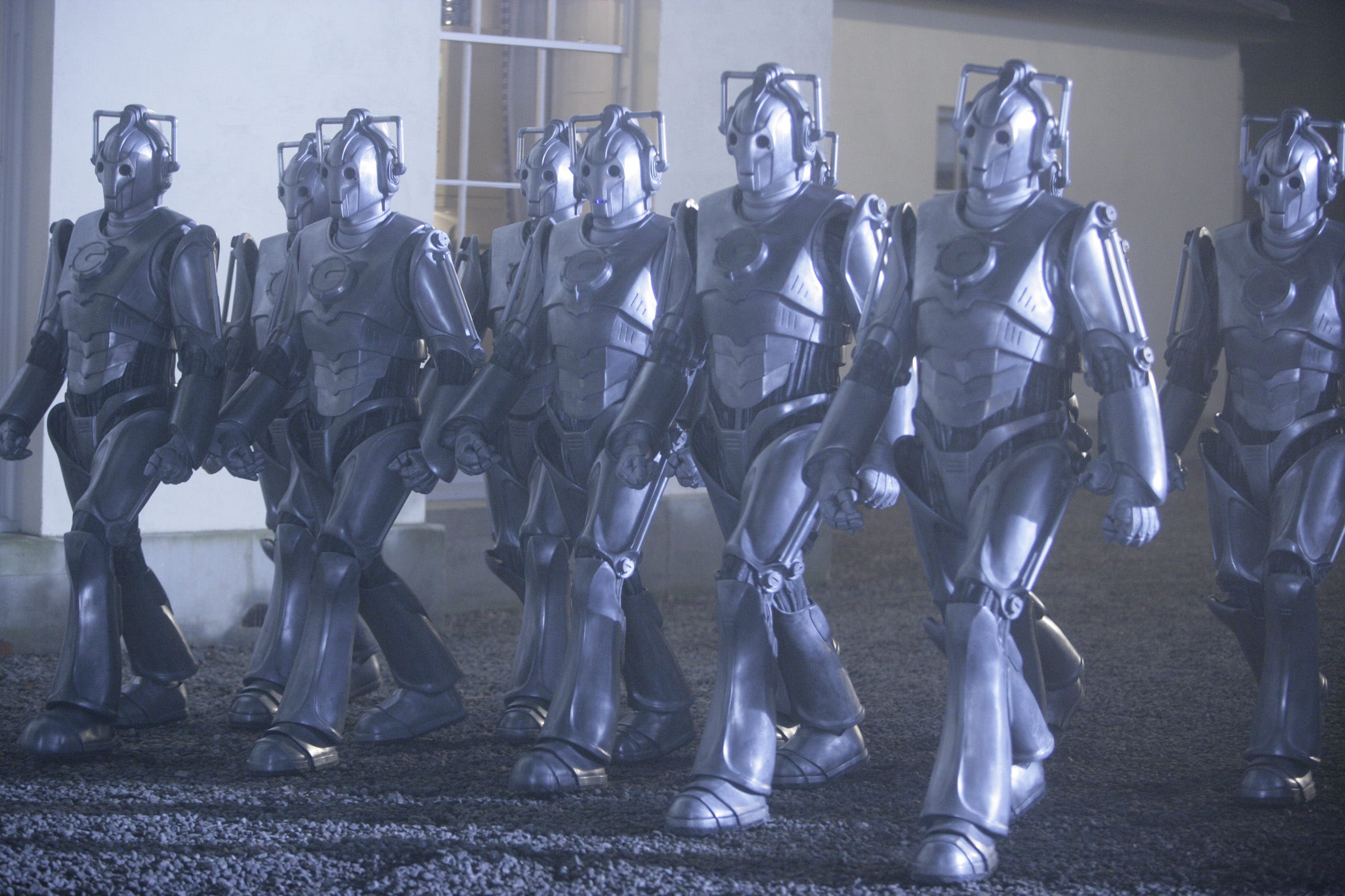
Choreography is great: The Cyber-marching is all pretty spot on. The “disco” moment in the factor is inadvertently hilarious, though.
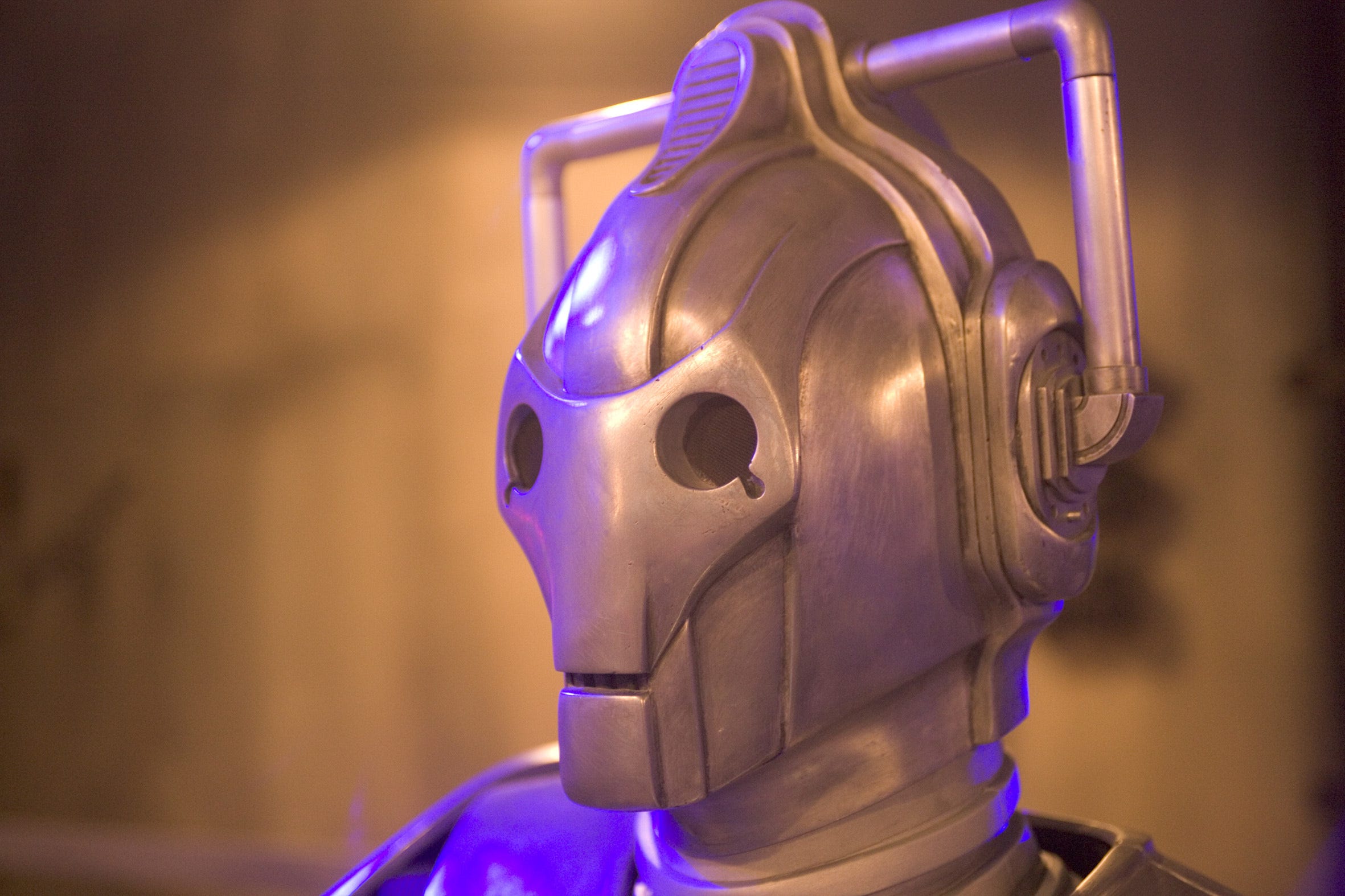
Let’s talk design: It’s very, very good. Finally, you get the sense that these Cybermen are heavy, formidable, and built like tanks. A lot of that is thanks to the sound and sound editing. The Cyber-stomp is now an integral part of these monsters, and it features in pretty much every appearance since. It also conveys what they are extremely succinctly: You never question why the Cyberman don’t run because it’s extremely obvious, just from the sound, that they’ve traded speed for durability.
Overall, the idea of these creatures being made of steel works better than being “silver,” which is vague.
The story:
This early in the series, you half-believe the Doctor when he says the TARDIS is “dead.” Sure, you know the series won’t end here, but it’s great that they keep the stakes high even after the Doctor solves the problem. He says they will never be able to return to this universe. Of course, he turns out to be wrong, but we didn’t know that at the time.
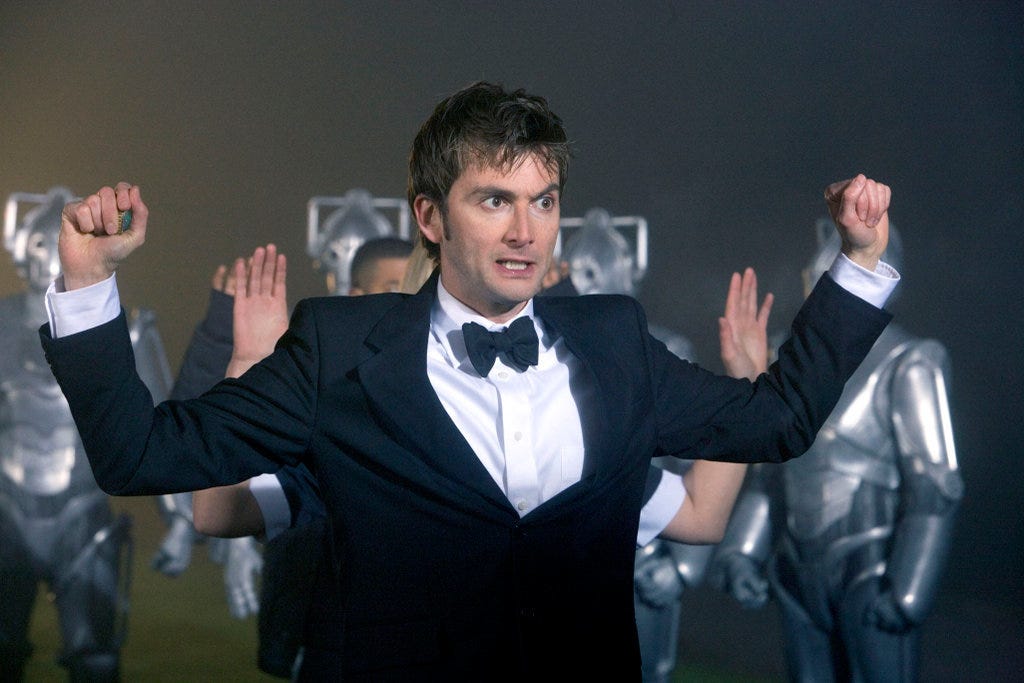
Introduces the idea of regeneration energy being something the Doctor can tap into whenever he wants. I don’t like this development overall for the series, but it does work for the story. Tennant is great at the emotional beats: “Worth every second.”
The zeppelins is a neat little way to emphasize that it’s a parallel world. If you’re hardcore into sci-fi, you know it’s a trope, but the point is that it’s a trope. Also, the vast majority of the audience will simply take it as a signpost of it being parallel.
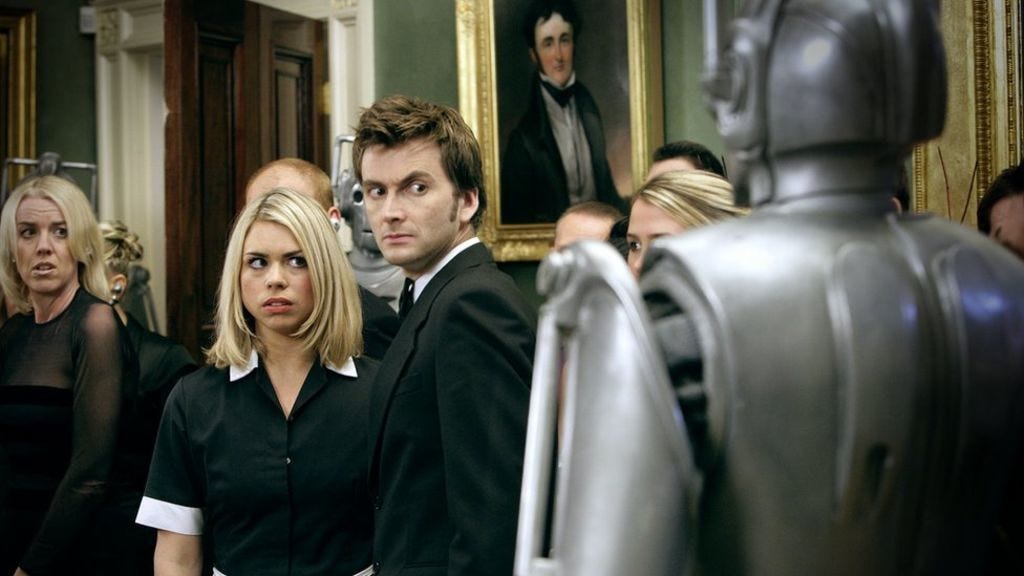
The cliffhanger is fantastic because it stays a step ahead of the fans. The first time I saw this, I was practically yelling at the screen that they should surrender. In fact, the story gives that solution: The Cybermen tell all the party guests that they will be upgraded and only start killing people when they resist or flee. So it’s great that the Doctor and the “gang” try this and it doesn’t work. You’re definitely think, “Oh, shit.” And you really don’t know how they’re going to get out of it.
That said, the Doctor using the TARDIS component to kill the Cybermen feels a bit like a deus ex machina. We’ll take it—it’s not completely out of nowhere—but it’s really convenient that the “beam” bounces from one Cybermen to the next, on and on, and kills just the Cybermen. Uh, ok.
The EarPods/AirPods connection is a little too perfect, and a little too off. This was done right when Bluetooth earpieces were taking off, at least with a certain set. It’s perfect because obviously AirPods—which are this idea, but done right—came just a few years after. It’s also off because it stretches credulity that the people of Earth would ever decide that wearing these clunky pods on their ears would be acceptable.
Pretty cool that they end up at Battersea Power Station, the same place that kicks off The Dalek Invasion of Earth. There seems to be also a subtle reference to The Five Doctors: “We attack on three sides. Above, between, below,” which was exactly the same strategy for getting in the Dark Tower.
Some parts of the plot are off target:
The bit early in Rise where all the people stop and act hypnotized is pretty nuts. People don’t do that, generally, and it would be really inconvenient for someone, say, pouring coffee or performing surgery. It’s a nice bit that emphasizes creepiness, but it stretches the realism a bit too far.
Lumic is truly nuts. How could anyone, who has lived as a human being, who has presumably experienced some kind of happiness at some point, would ever think life as a Cyberman isn’t just a last-resort longevity move, but something that is actually preferable—so much so that the entire world should be converted. I know all megalomaniacs have to have this kind of leap, but in Lumic’s case it’s ludicrous.
Crane has been with Lumic for decades. He’s basically Lumic’s Nyder. He’s fully in the know of what Lumic is planning, or at least he must have some idea—even if he doesn’t know it’s explicitly world conquest, he knows that he’s converting people against their will en masse. Why would Lumic just treat him the same as all other human fodder? That’s really stupid.
There are plot conveniences aplenty at the end:
How do Jake and Mickey get on the roof unopposed?
Why are there humans guarding Lumic’s zeppelin instead of Cybermen?
Why do the Cybermen think Pete Tyler should be “rewarded by force?” Pete wasn’t an inside man like Crane. And what “reward” would this be anyway? And why do they bring Rose along? She’s a nobody.
Similarly, why do the Cybermen proactively scan the Doctor to learn his physiology? Which, OK, might be something they want to investigate. This one could have been solved by the Doctor telling them to scan him before they kill him.
Finally, when Lumic comes out as the Cyber-Controller, it’s really cool and all, but he gives no sense of why he’s keeping anyone in the room alive.
The ending with the Cyber-Controller climbing the rope ladder after them is great, but it’s straight out of Aliens.

Rose and her family:
Billie Piper is great in this. She says so much when she’s not saying anything. It’s this perfect situation where she knows intellectually everything the Doctor is saying to her about this not being her world or her parents. But it’s the kind of situation where you start making up your own reasons for pursuing what she wants—or thinks she wants.
Similarly, her scenes with alternate Pete and Jackie at the party are really well done. Her conversation with Pete brings about a natural connection just like in Father’s Day, which is a nice echo. That emboldens her to talk to her mother, which of course turns out very bad.
Camille Coduri delivers her acidic lines—particuarly the one to Rose—extremely well. She’s always been a bit OTT, but it’s hard to watch that intensity put through a cruel lens. Superb choices here.
I really love it when Piper plays jealous Rose. The bit where she says maybe Lucy’s “a bit thick.” lol
Similarly, when Rose suddenly realizes that “Rose” is the dog (she already knows she doesn’t exist on this world), it’s a perfect chaser to the seriousness of the Doctor’s speech to her about this not being her world/parents.
The final scene between Rose and Pete is nicely played. Rose wants to tell him who he is to her, and she does, but he can’t handle it, which is exactly right. He just lost his wife in the most horrific fashion. He’s got a lot to sort out.
Mickey/Ricky:
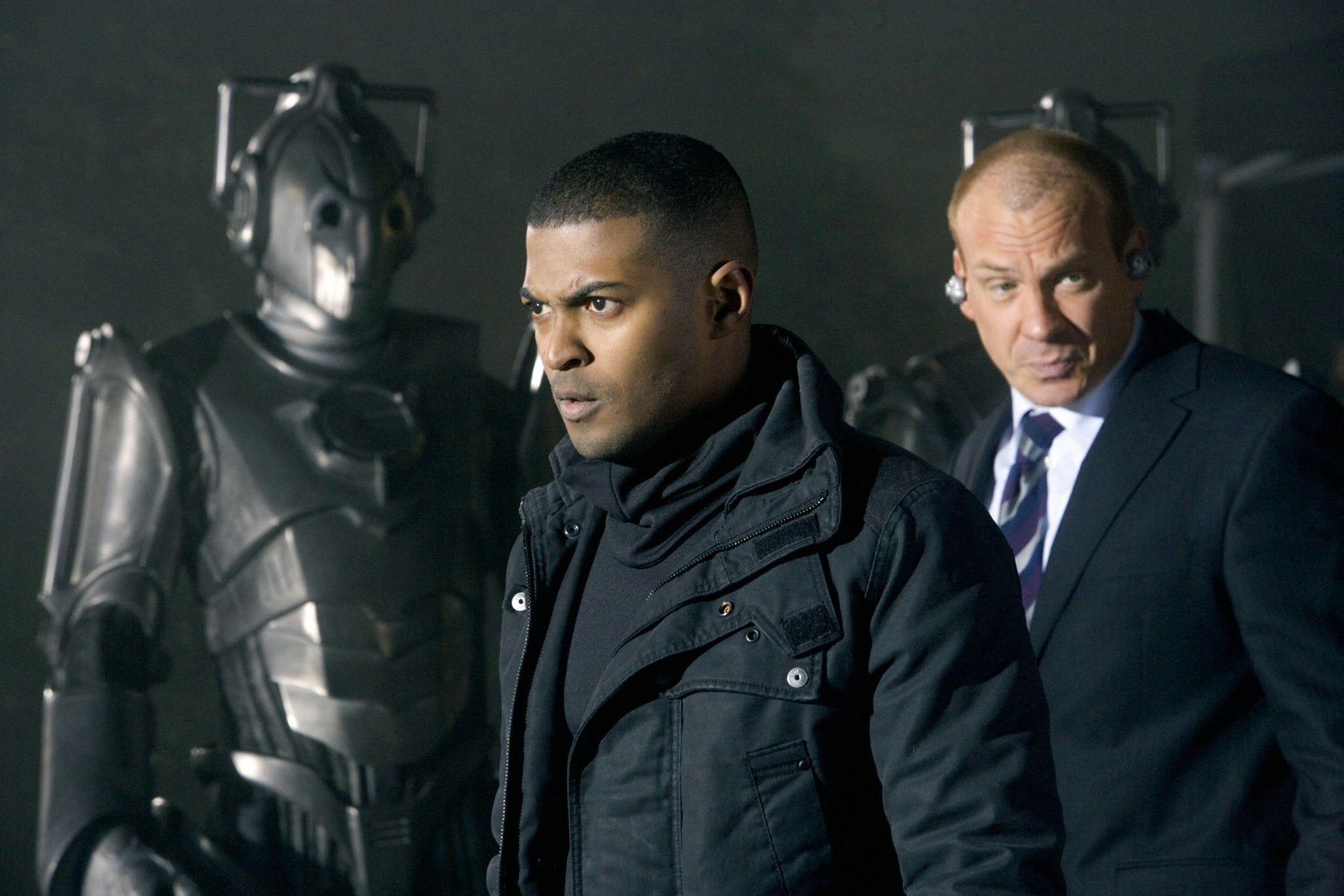
This is the culmination of Mickey’s arc. Yes, we all know now he returns in the season finale, but that story isn’t about him. This one is. The cardboard coward from Rose is now fleshed out and much braver after his experiences.
The direction Mickey chooses—to stay in Earth 2—is influenced by many things. It’s never explicitly stated, but when Mickey asks to go with the Doctor in School Reunion there’s a part of him that probably thinks he can reconnect with Rose by sharing these experiences with her. But the opening scene emphasizes he can’t compete with the Doctor—their bond is just too great. Also, he spent a year being ostracized because everyone thought he was responsible for Rose’s disappearance. And of course the thing with his gran (made up for this story—Rose mentions his mother in “Rose”).
Ultimately, though, it’s all about him finding his voice, choosing his path, being brave. The early scenes are almost meta: Mickey’s accusations that he’s always going to be an afterthought are undoubtedly true, and I love that he tries to get Mickey on his side to keep Rose from being tempted, and he’s basically asking if he’s chopped liver. He’s stepping out of the show almost: why are you assuming I’m a stock character?
Noel Clarke plays Ricky with a permanent scowl on his face, and shovels a little bit of “Batman” gravel onto his voice. It’s a bit superficial, borderline silly, and turns Ricky into a bit of a caricature. You can look past it, but it’s a bit painful to watch in hindsight.
That said, it was probably destined to be a half-caricature when they decided to name Mickey’s counterpart Ricky, an obvious in-joke referencing the Ninth Doctor’s nickname for him.
Mickey shares a final kiss with Rose when he goes to help Jake.
Music:
Huge shout-out to Murray Gold for absolutely nailing the Cybermen’s theme. It’s so iconic at this point that it’s been used I believe in ever single Cyberman episode since—even ones where they’re not the main villain.
One of the reasons it’s so effective, besides being really distinctive and hummable, is that it can be played all kinds of different ways. The higher-key version when it’s trying to convey intrigue and mystery works just as well as the “march” version.
Misc:
“Set sail” for Great Britain is a really cool cut-to-credits line. Brings the action home to a UK audience and is obviously a big mislead that they’re on a boat.
The PETE 1 license plate is a nice reference to Bessie’s WHO 1.
Venezuela mention! Jackie’s earpods can apparently get signals from there.
I like the Doctor’s retort of “you never said” to “you never asked.” I’m on his side here—how are you supposed to know what’s important to someone in every situation if they don’t say?
“The Lion Sleeps Tonight” is a little random for playing over the screams of Cyber-conversion, but it’s still a chilling moment.
Mickey/Ricky’s abs almost look CGI!
Torchwood mention!
Lumic’s chuckle to the president is a bit much.
Ricky saying he’s London’s most wanted for traffic violations is pretty funny, and I really like the Doctor’s line that he does much the same.
Ricky’s death is a bit unexpected, but I love the moment right after where Mickey is staring at the Cyber squad on the other side of the fence and they just silently stare back. It’s the Cybermen’s most zombie-like moment ever. That said, it’s a bit confusing whey they don’t just smash through the fence. Perhaps they’ve been instructed to not damage too much infrastructure?
Jake’s reaction when he hears Ricky is dead is so intense that you have to think the bond goes deeper than just friendship. It’s obviously not explicit, so you can interpret as you see fit, though the theory that Ricky, obviously an exact genetic duplicate of Mickey, might be gay, might bring up some uncomfortable questions if you think too hard about it.
Hints that Pete’s world might not be so rosy: There is a curfew. Is the president… uh, elected?
Poor Mrs. Moore. You know she’s going to buy it when the Doctor and she are going through the tunnels. But the actress is great, and you really sympathize. Another almost companion.
Why is Lumic’s Cyber-Controller still sitting?
What did Pete’s family think?
Grace likes this one a lot, though we saw it fairly recently. She thought the earpods were tacky. But she loved all the twists with the parallel world people.
Four Questions to Doomsday - Pete
Why did the Randomizer take us here? PETE 1 is a play off Bessie’s WHO 1, first seen in Doctor Who and the Silurians.
What if the evil plot had succeeded? It kind of should have, if you think about how much an upper hand Lumic/the Cybermen have when the Doctor, Rose, and Pete are their prisoner. Say, they all die. No one’s there to tell Mickey to send the code, so the Cybermen conquer London and subsequently Earth. Would they still get sucked into the parallel (our) Earth? Or do they just become a Cyber Empire in Pete’s universe? That could end up being Cyber-dimension.
Where’s the Clara splinter? She’s Cybus’ HR manager and runs all the office parties and birthdays. Somehow that file got into the Cybermen’s master program, amplifying the need for “rewards” for all Cybus employees. Top priority.
Dalek, Ogron, Professor Hayter, Viscount Banger, Fixed Point in Time, Lady Cassandra, or Zarbi? If you’re not religious about the Cybermen in Classic Who, this is the best possible re-introduction of them. For Cybermen fans, it’s a banger. For everyone else, it’s good Doctor Who. It’s a banger-Dalek hybrid.
Chris commentary:
Let’s talk Pluribus! The Lumic Cybermen are basically exhibiting the same “biological imperative” to upgrade humans as The Joined do — they want to end our suffering, and their own emotions are being suppressed (Pluribus is so far only hinting at this part). I’d love to see a cyber story in the future that’s more explicitly built around the “what if zombies but nice all the time” notion that makes Pluribus such a brilliant subverter of sci-fi tropes.
Likewise we really need to see more of the “constant upgrade” concept, the notion that our gadget ownership is accelerating faster than we can really keep track. And then you wake up one day with a Whoop and an Oura and an Apple Watch attached, when you really meant to reduce and simplify …
Likewise, Cybermen could help explore our growing modern horror at the “enshittification” of tech. They’re kind of the ultimate enshittification.
And AI! What if Cybermen hallucinated, like, 20 or 30 percent of the time!? That would be mad, in the RTD sense. Now I kind of wish he’d done Robot Revolution as another cyber origin story instead.
Side note: I wish the show had told us what Lumic is dying of, exactly. I get that it doesn’t really matter but if you just go for the body horror of it without naming the disease, he’s just a distant 2D nut job instead of a real character.
Trigger warning! That is, everyone in the UK looks at Lumic, then and now, and thinks “Trigger!”
Good thing I’ve just been reading Luther Arkwright and know all about the Zeppelin = parallel world trope. Shame Michael Moorcock doesn’t get a shout out.
Likewise, Lumic’s parallels with Davros are so obvious that you kind of want the Doctor to give that a shoutout too.
The double earpiece thing was inspired at a time when we all had the one headset. Now it looks prescient. I definitely noticed them less this time around …
WHAT WAS THE DAILY JOKE