

Plot summary
An ancient Time Lord mistake comes back to haunt the Doctor as he tries to unite two races against a megalomaniacal tyrant.
Notable for:
Story editorially overseen by new script editor Anthony Read, who replaced Robert Holmes
Writers Bob Baker and Dave Martin drew heavily on Greek mythology, reworking the story of Jason and the Argonauts into a science-fiction quest for lost “race banks”
One of the most extensive uses to date of colour separation overlay (CSO/bluescreen) to build the story’s cavern and tunnel sets, a technique that proved difficult and time-consuming for cast and crew
Features the Minyans, a race whose earlier contact with the Time Lords ended in catastrophe, providing rare on-screen backstory for Gallifrey’s policy of non-interference
The Oracle’s rule over the Trogs, enforced through manipulated belief and false prophecy, echoes the series’ recurring interest in computer-led societies and religious control
Production was affected by the technical demands of the model and CSO work, contributing to Underworld’s reputation as one of the more visually strained stories of the Tom Baker era
Pete commentary:
Underworld is an amusing retelling of Jason and the Argonauts with a Doctor Who veneer. It’s a bit inconsistent in its scale, but it’s pretty neat how it folds the story into not just space, but the Doctor Who mythology: By making the Minyans the first—and last—race the Time Lords ever tried to “engineer,” it immediately gets fans to sit up and pay attention. It’s similar to how Horror of Fang Rock is elevated by the monster being a Rutan. It’s lore-building.
If anything holds back Underworld, it’s that it feels the need to hew too close to the source material. If they had taken more liberties to build on the lore they were establishing, it might have been epic.
For example, one of the issues is that it’s unclear what the antagonists are doing and why. They’re on this semi-hidden planet, forcing the “trogs” to work for them, and generally running a small, stagnant slave empire. But… why, exactly? To what end? It feels like the Minyans have just stumbled upon them, even though they have history, which weakens the conflict.
I admire the ambition to tell a story with grand sci-fi scale. And it’s actually more consistent than it seems:
The script says the Minyans traveled “from the other side of the universe” over 100,000 years on their quest. Although the scale of the universe is so vast it’s hard to picture any “ship” going from one end to the other, it’s Doctor Who, and we’re talking about a civilization upgraded by the Time Lords.
Plus they can regenerate, and it looks unlimited. This is actually fairly consistent with later lore (the Timeless Child) but even the lore at the time, since The Brain of Morbius implies the Time Lords set the 12-regeneration limit to ensure they could still progress. In other words, limitations on regeneration seem like a rule of the Time Lords, not a biological law. There’s no reason the Minyans would have the same rule.
The Doctor says the planet is in the process of forming, but planet formation takes millions of years. If the P7E has only been here 100,000 years, with the planet forming around it, a soft planet actually makes sense.
That said, the cosmic-scale stuff is slow and gradual when needed (the planet) and fast and destructive when needed (the whirlpool nebula).
We should probably talk about the blue screen effects. They’re very obvious, and it does weaken the execution. Obviously they’re a symptom of the stretched budget and continual transitioning of production teams who don’t know how to manage it. They did make the best of it, though, and you can reasonably keep track of what’s going on. And on the bright side, they do give the whole affair a surreal quality, which arguably matches the mythological elements of the story.
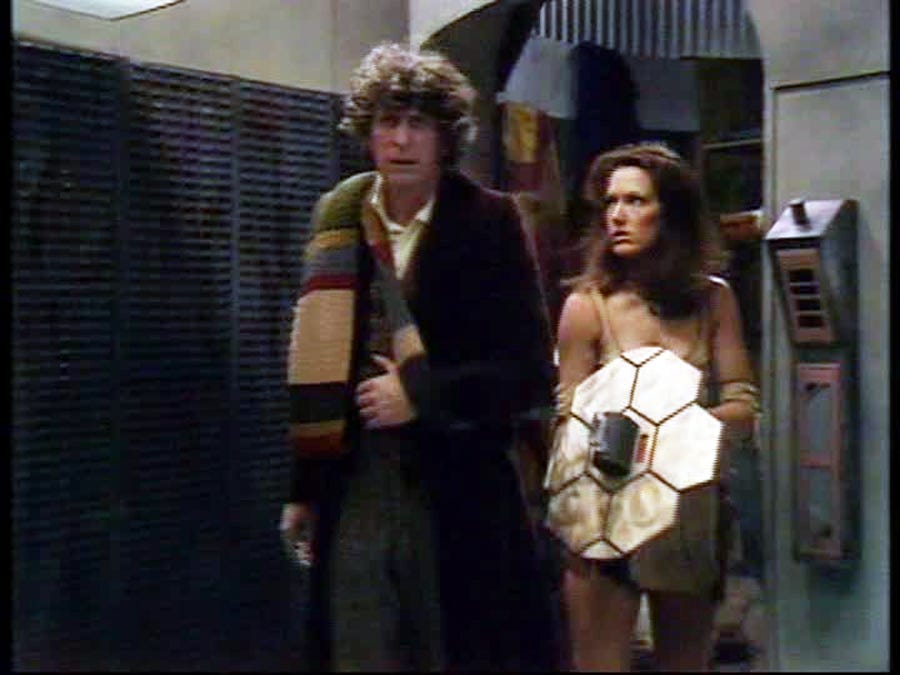
Let’s talk about the lore for a minute. So the Minyans were the Time Lords’ first experiment at world-building and first contact, but were eventually “kicked out at gunpoint,” according to the Doctor. Fair enough, so why then do the Minyans look at the Doctor as a god and defer to him so much? Similar to The Ark, there’s an element of colonial fantasy at play here, in this case the former colonizer gives you deference, and any resentment from the past is left in the past.
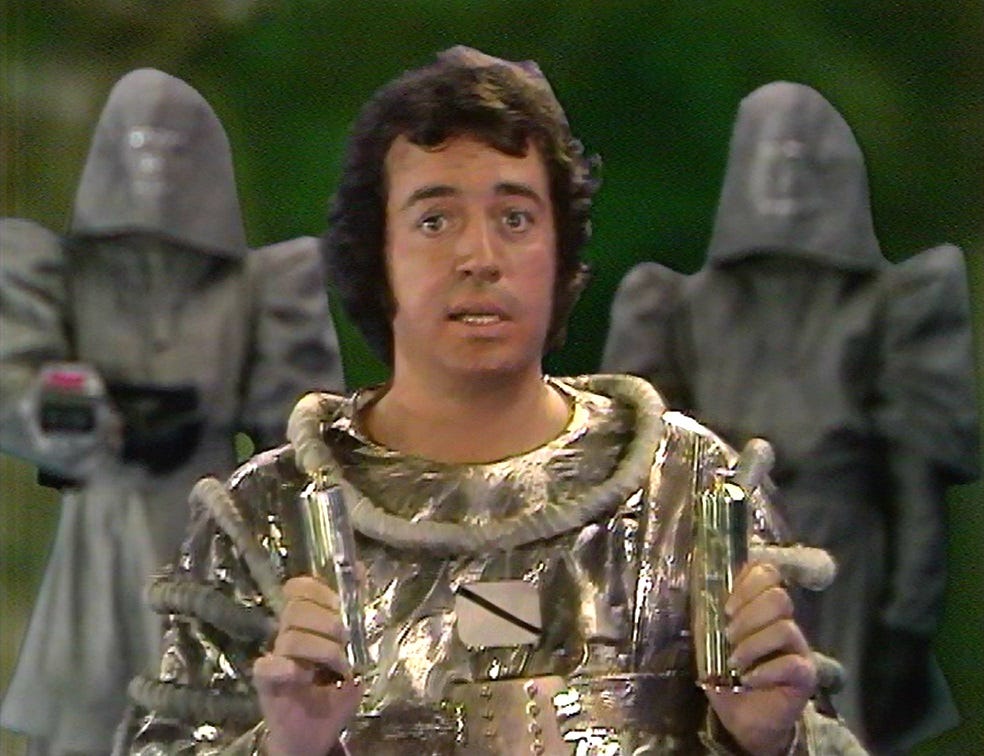
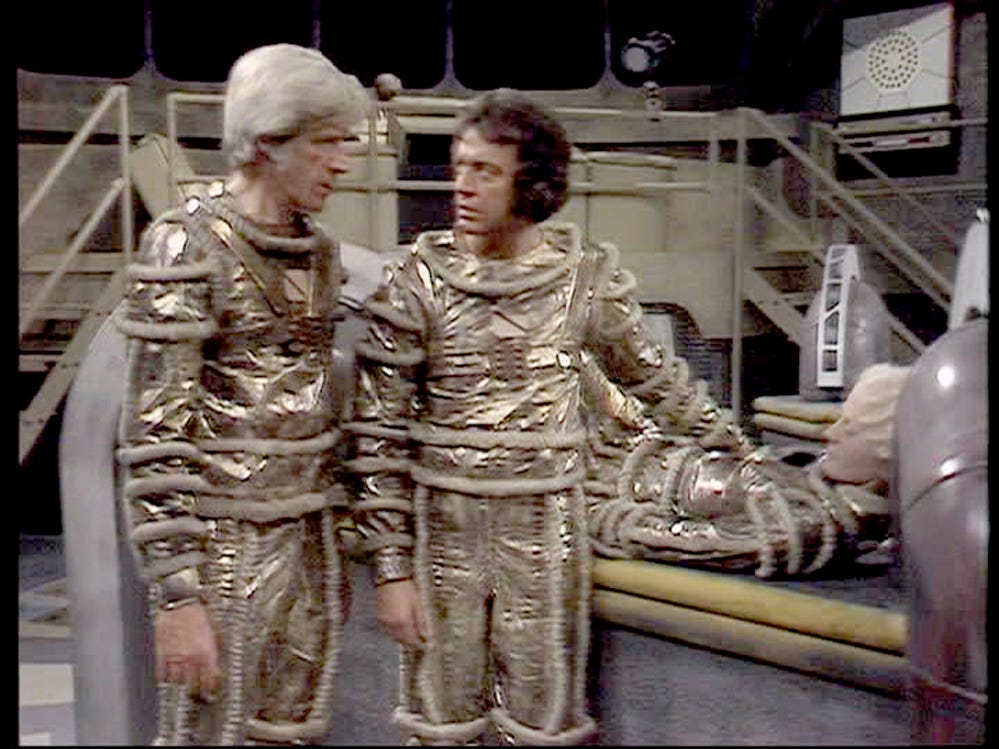
James Maxwell as Jackson follows a long line of “stolid older guy doing his best to lead” characters, which includes Bernard Horsfall as Goth and Taron, among others. It’s a little tired by now.
Much more memorable is Alan Lake as Herrick. His torture scene in particular is excellent, with him trying to not confess while also turning the tables on his captors.
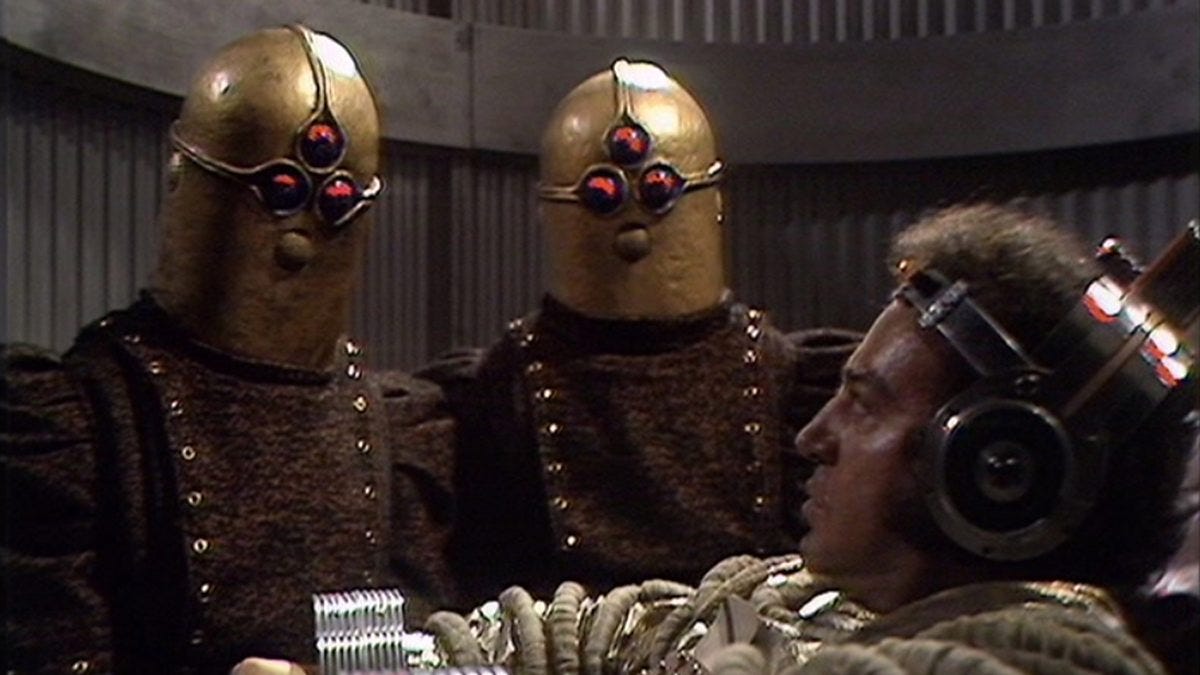
The moment where the Seers reveal themselves to have metallic faces is shocking, but it’s unclear what we’re supposed to take from that. They comport with the Argonauts story as “dwellers of Hades where Persephone [the P7E] is held captive during winter,” but… are they robots? Is it another mask? My take is that they’re robots. They are essentially constructs of the computer to be its eyes, ears and hands to ensure the trogs stay enslaved.
The weakest part of the story is the Trogs. We don’t really get to know or like any of them enough to care about them. Whereas the Minyans have that interesting history with the Time Lords, and the two best performances of the guest cast in Herrick and Jackson, the Trogs are entirely forgettable. Someone is related to someone else and sacrifices themselves so the race can survive? Who cares?
The best moment the Trogs have is actually a Doctor moment, where he lectures Jackson that the Trogs are his people. Which is true. You kind of wonder if Jackson even understood the plan since it involved giving the fission grenades back and essentially blowing up the planet. What did he think was going to happen to them?
This is a GREAT K-9 episode, where he gets to save the R1C, run around caves (not many episodes where he can do that), save everybody by blasting a rock wall, and he has a hilarious final line: “Negative” to the Doctor’s speculation that Jason and the Argonauts might have been predicting the future. He also tees up the Doctor’s reaction to the “2,000 megatons” of the fission grenades: “I think I’d better get rid of them, don’t you?”
What did Pete’s family think?
Watched this one solo.
Four Questions to Doomsday - Pete
Why did the Randomizer take us here? Like The Ark, the Randomizer wants to show us how often Doctor Who went waaaaaaay back for story inspiration—in this case, Greek mythology.
What if the evil plot had succeeded? The Doctor doesn’t get to the R1C in time, they take off with the fission grenades. They blow up a short distance from the planet, and the Doctor must then figure out how to defeat the computer, rescue the slaves, and recover the TARDIS from the explosion. He’d better hope he left the HADS engaged! That’s another Randomizer reason:
Where’s the Clara splinter? Part of the original P7E crew who designed a “ladies” version of the shield gun, which caught on tremendously.
Dalek, Ogron, Professor Hayter, Viscount Banger, Fixed Point in Time, Lady Cassandra, or Zarbi? Honestly a Zarbi. Looks terrible, super derivative, wildly inconsistent. But there’s something kinda cool here, powered by the lore of Doctor Who and a few smart reveals in the last two parts.
Chris commentary:
The spaceship becoming a planet thing — brilliant cliffhanger.
Aberdeen granite radiation is absolutely wrong. This isn’t a great story for true science. “Physics isn’t luck, physics is facts … are facts?” indeed.
Also not a great story for continuity – Sarah Jane and Aberdeen I can forgive him not mentioning, but how did he forget he gave the idea for the horse to Ulysses??
Four Three Questions to Doomsday - Chris
Why did the Randomizer take us here? I wanted the Ark but more scale, and that’s exactly what this is. Plus: Greek theme, Ulysses mention — the Nolan cash again! And Minyans — as we’re recording this a new Minions movie just opened. Has the Randomizer sold out to Hollywood?
Where’s the Clara splinter? Time Lady Clara appears in a TARDIS to blast the R1C with cultural memory inhibitors so everyone immediately stops caring that the Doctor is one of the hateful Gods. This also explains why the crew can hear a TARDIS noise unlike any other spaceship crew in Who history — it’s because there are actually two materializing at once.
Dalek, Ogron, Professor Hayter, Viscount Banger, Fixed Point in Time, Lady Cassandra, or Zarbi? Clear cut Prof Hayter. Tried something in scale and scope and CSO. Did not succeed on any front. Tried to teach us something about what physics are.