

Plot summary
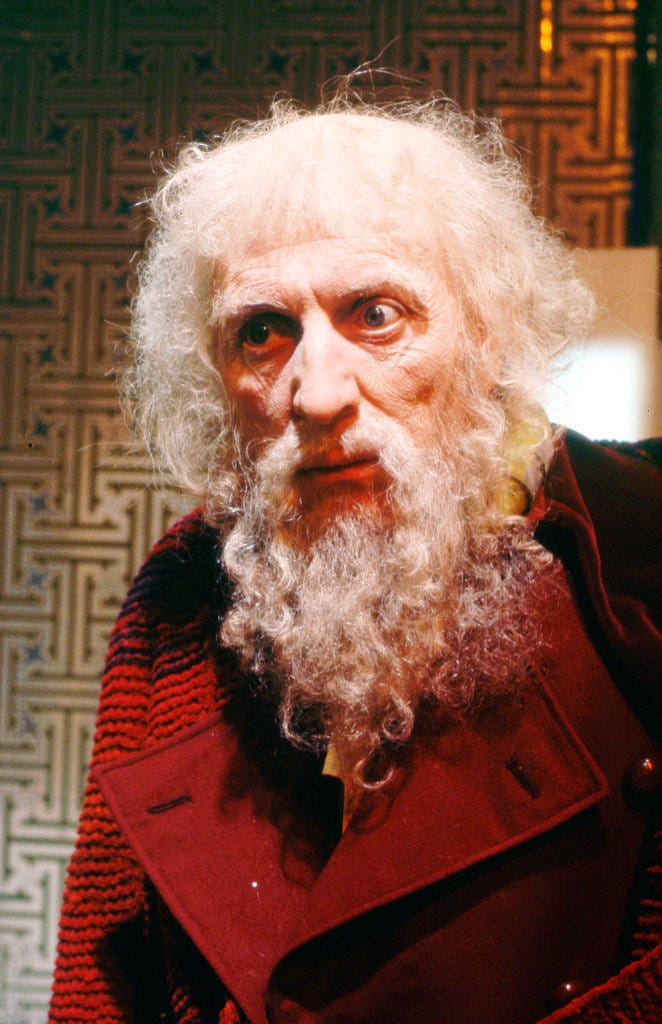
The Doctor becomes an old man when he enters a high-tech attraction at a cosmic resort that’s been targeted by reptilian gangsters.
Notable for:
First story to feature the new John Nathan-Turner era title sequence and Peter Howell’s new arrangement of the Doctor Who theme
First story produced by John Nathan-Turner, who would produce Doctor Who until 1989
K9 is written out of most of the serial when a wave knocks him into the sea in the opening scene — a deliberately undignified exit, as Nathan-Turner was keen to reduce K9’s prominence
Tom Baker and Lalla Ward’s relationship was at a nadir during production, making for a difficult atmosphere on set
Director Lovett Bickford’s approach pushed the serial significantly over budget, and he was never asked to direct Doctor Who again
The opening sequence on Brighton Beach was the first Doctor Who location filming to use a brand-new, steadicam-style camera rig
The baby Pangol seen at the end of the story was played by Alys, daughter of production manager Anji Smith
Viewership ranged from 5.9 million (Part 1) down to 4.5 million (Part 4)
Pete commentary:
This is it—the JNT era begins with The Leisure Hive. You have to think back to how cool and unexpected it must have been to tune into Doctor Who and instead of the time tunnel, you’re greeted with the stars rushing at you and the neon logo and Peter Howell’s synthesized version of the theme. It definitely sets a tone: we’re back, we’re all-new, and we’re ready for the ’80s.
The JNT era is distinct in many ways, and much of the style begins here:
The soundtracks were modernized with more ’80s synth (bye, Dudley Simpson). The Leisure Hive’s music wasn’t done by Paddy Kingsland, but you can feel it’s more in that style.
Everyone’s outfits got more costume-y, and the Doctor acquires question marks on parts of his clothing, something that would feature until the end of the program in 1989.
The stories veered more toward hard sci-fi, influenced largely by script editor Christopher Bidmead (RIP)
There are many long mood-setting shots of the exterior of the Hive. It honestly feels like padding, particularly early on when you don’t have much to go on (the war, the dying Argolins, etc.).
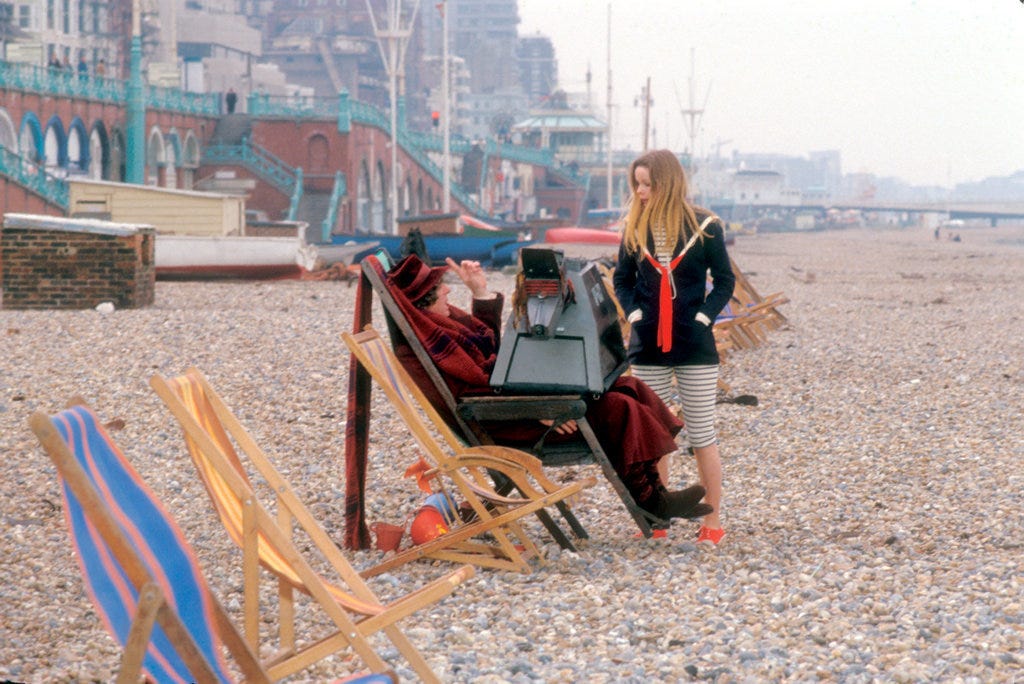
Those shots contribute to a really slow pace early on, with the extremely long pan along Brighton Beach. That scene is at least memorable, with the Doctor and Romana showing some good banter early on (“Well I can’t get everything right”).
Why does K-9 literally blow up when he touches sea water? His lack of seawater resistance is a really silly way to write him out of the story. It’s surprising John Leeson didn’t walk again, given how he was written out of his first story back.
The story is ostensibly a parody and parable at the same time. It’s satirizing declining tourism (something the UK was experiencing in the late ’70s, apparently) as well as the mafia (Foamasi is an anagram of mafiosa, the lodges are similar to families). But it’s also a cautionary tale about nuclear war, with Argolis devastated and the Argolin society on its last legs. What is this story supposed to be about? It can’t seem to decide.
Then there’s the magic box of the tachyon chamber. Putting aside how random it is that a dying race has somehow achieved some kind of scientific breakthrough, it’s never fully explained what this thing is supposed to do. They imply that the Argolins have leveraged it to essentially clone members of their race, which is how Pangol came to be. But then why ban more clones for 20 years? Isn’t it pretty urgent that you solve your sterility problem?
There’s also the idea of using the chamber as a rejuvenator—a fountain of youth. And it works! But only with the help of Romana, apparently. So tachyonics alone can’t achieve this, but with some aspect of Time Lord science applied, it can. Does that mean it can only do this one time, while the Doctor and Romana are there? Does leaving the Randomizer have any significance (i.e. it can do this as long as the Randomizer stays there)? And wouldn’t “the whole course of natural evolution throughout the universe” be affected, to quote the Inquisitor from Trial?
Also, why does it take a human (Hardin) to make the breakthrough if it’s the Argolins who have put all their scientific eggs in the tachyonics basket?
Also, the Randomizer somehow being a factor here is clearly an excuse to get rid of it. (In the novel, it gets smashed when the Doctor drops it.) Kudos to JNT, though, for making the decision to get rid of it. We don’t need a device to make the TARDIS unreliable, and the Doctor’s point about not wanting to live forever in fear of some bad guy chasing him is well taken.
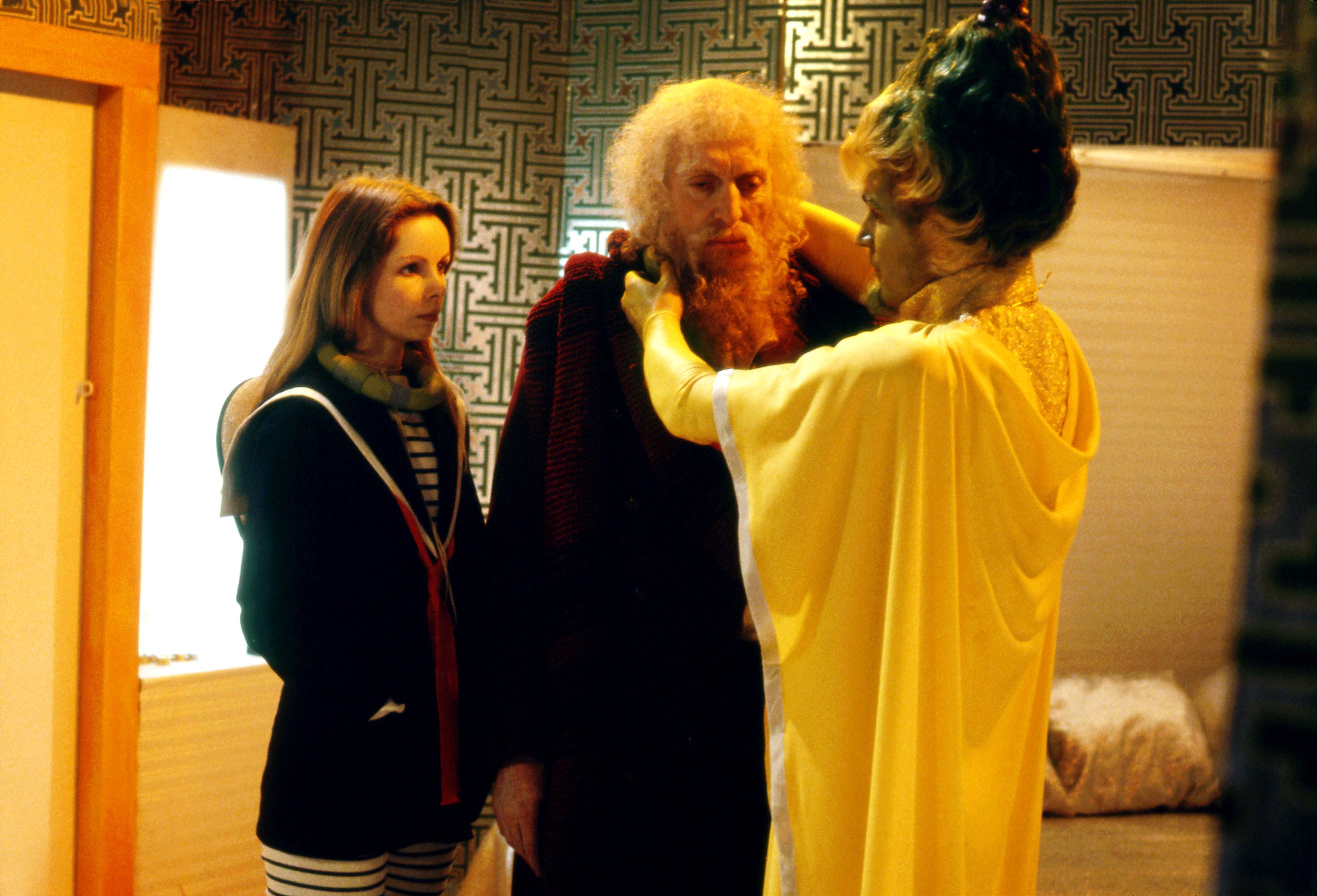
Baker’s “old guy” makeup is actually quite good. He never quite acts old in a way that’s convincing, and I don’t think the script gives him much opportunity. It would have been good to give him a cane or walking stick, or emphasize that he’s losing his memory. There’s more of this in the novel.
The twist in episode 4 that all the Pangol duplicates are really the Doctor is kind of cool, but you have to think—how did that happen? And how did the rejuvenation take place at the same time? Yes, the Doctor was in the chamber, but he wasn’t wearing Pangol’s clothes, and the chamber looks so small—why didn’t Pangol just take a minute to get the Doctor out of there?
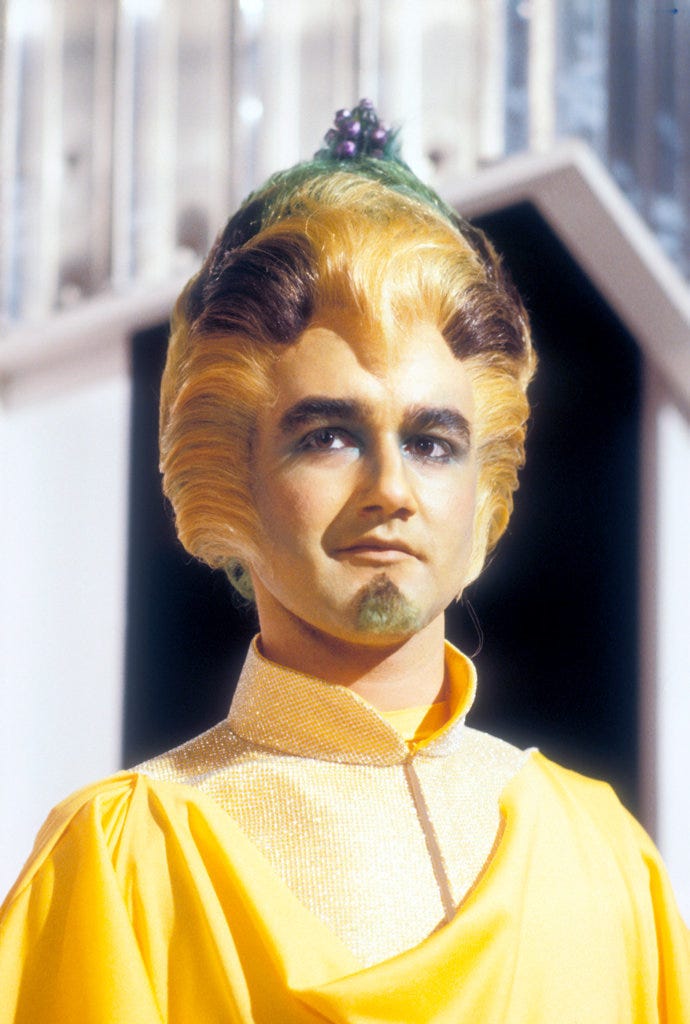
I must say, I like the design of the Argolins. I could have done with a bit more variation in their costumes, but the hair, the makeup, and the little marbles that fall off when they start to die—all very original.
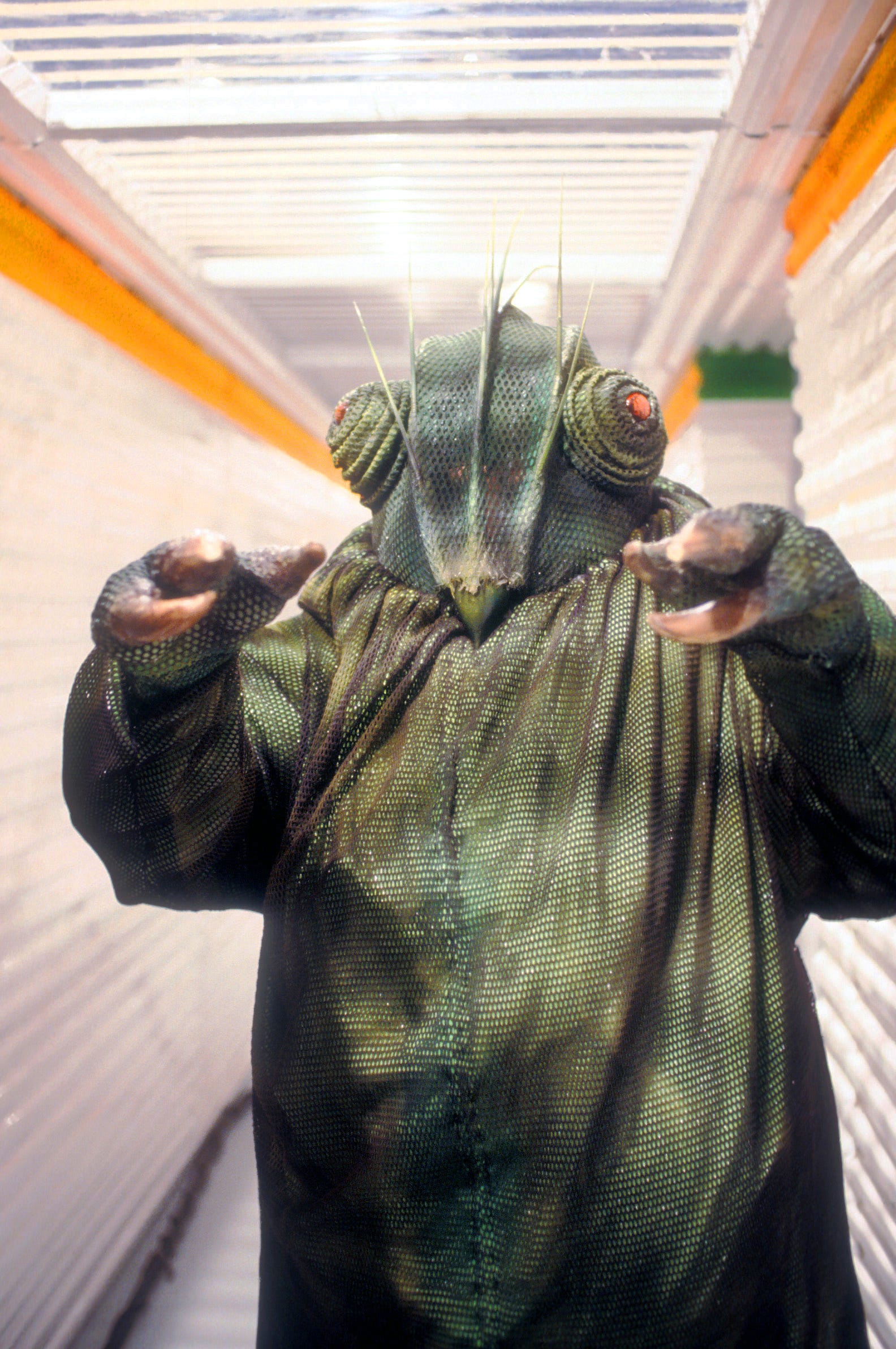
I like the subplot of having the Foamasi be a bit two-dimensional as the “mystery” bad guy: that there’s a criminal faction and a government team dispatched to deal with them. And, structurally, I like that the story tries to get you to focus on the monster when the real bad buy (Pangol) is front and center. I just don’t think it does enough work to make me care about either.
Very strange that the TARDIS doesn’t translate the Foamasi language.
Four Questions to Doomsday - Pete
Why did the Randomizer take us here? Now that we’re halfway through, the Randomizer felt the need to confront something—the end of its journey. It ends where JNT begins. Whatever you think about his decisions, they are deliberate, so I take the message here to be that living intentionally is perhaps the best course anyone can take.
Also, both The Leisure Hive and The Greatest Show in the Galaxy feature public-facing performances that mask something darker beneath. Plus the Doctor becomes a part of both shows, which never quite turns out well.
What if the evil plot had succeeded? Thinking about Pangol’s evil plot: He recreates himself, over and over, and raises a new Argolin army. Argolis has no resources, though, so where does his army get equipment? He’s going to need money, partners, etc. I don’t think it would be a good idea to declare war on the Foamasi on day 1, as he seems to intend to here. More likely, the last remaining Argolins are wiped out pretty quickly once he starts to rattle his saber.
Where’s the Clara splinter? She deletes the Foamasi language from the TARDIS’s memory banks so the Doctor doesn’t put things together too early and miss his chance to get into the tachyon chamber to rejuvenate/duplicate himself.
Dalek, Ogron, Professor Hayter, Viscount Banger, Fixed Point in Time, Lady Cassandra, or Zarbi? This is a Hayter, but it’s also a Fixed Point in Time because of how notable the story is. Fixed Hayter in Time.
Chris commentary:
I don’t have to imagine how new and weird the starfield intro, new theme etc. was – I was there! This is the first story where I have a distinct memory of watching with my dad, of both of us being surprised by the new theme, slightly disappointed by the no time tunnel but on board with the starfield – no McCoy-like reaction here! – and of him laughing at the opening Brighton Beach shot …
… which gets a bad rap. Think Monty Python! Those overly long intros concluding with the “It’s …” man is the comedy vein they’re going for here. And it works if the show has been off the BBC for the whole summer.
Definitely remember K9 being done dirty. Why does it seem like Romana messes up the whole TARDIS crew here?
Let’s talk Buck Rogers
I sort of remember the horror of the Doctor being “torn apart,” but I REALLY remember the Doctor getting old. Terrifying! And I vaguely remember being disappointed when they hit the reset button on that …
Let’s compare to the other major old Doctor stories, both in new Who, both no doubt influenced by this – the Master Trilogy and Time of the Doctor. I love it every time the show does it. More old Doctor please!
The novelization is so much better, very much trying to be Douglas Adams in the first few chapters.
DNA’s fingerprints seem like they’re all over this, despite his total lack of involvement. Largely because HHGTG the TV show was being filmed at the same time by the BBC, also using the Radiophonic Workshop …
For this reason, I told myself that “Pangol” has a last name “Actic-Gargleblaster” and it totally stuck.
Interesting that Tom Baker has aged in real life now in a completely different direction … all the hair going up rather than down!
One unforgivably long scene, though, repeated twice – the shuttle docking. JNT was said to have edited a lot out to make this thing feel pacy, so why did that pointless model shot make the cut?
Four Questions to Doomsday - Chris
Why did the Randomizer take us here? Is it contemplating suicide? “There’s been enough Randomizing on this job” – perhaps it’s going on strike? Perhaps it wants more leisure time, to go to Centers of Leisure, to a circus, to a Hive – does the PTO randomizer need more PTO? Is it signalling that it is now “breaking free” of the TARDIS halfway through our adventure, and its choices are going to be even more wilful? Or is it just taking me directly to the most emotionally resonant stories of my childhood?
What if the evil plot had succeeded? Then Pangol unleashes an army across the cosmos … and it seems like Gallifrey might actually take notice of this aggressive tachyonic technology, despite being an “obscure planet.” They’d simply speed up the Argolin metabolism as soon as their invasion fleets left, and all the Pangols would go all Sarah Kingdom …
Where’s the Clara splinter? Time Lady Clara is putting the Doctor through regeneration therapy, starting to ease him into leaving this body, by means of tachyonic images (he’s not actually that old)
Dalek, Ogron, Professor Hayter, Viscount Banger, Fixed Point in Time, Lady Cassandra, or Zarbi? I’m not even hating, I don’t need a Fixed Point despite my nostalgia – this looks amazing (new burgundy outfit! The Argolin! Quantel ftw!) but the script has significant flaws. It’s a Cassandra all the way, and she’s really milking her death scene with little droppings appearing from the top of her paper-thin skin.